Beyond Drone Warfare: Hyper War Still Depends on Unmanned Ground Vehicles, Fiber Optics and Local Industrial Capacity

Updated: Sep 2
The war in Ukraine appears to offer overwhelming evidence for that conclusion. Reconnaissance drones, FPV systems and long-range strike platforms have expanded the traditional boundaries of the front line. Uncrewed surface vessels have altered the balance of power in the Black Sea. Ground robots are increasingly being used for logistics, transport and casualty evacuation in areas where sending personnel has become too dangerous.
But numbers are not the whole story.
The deeper transformation is that artificial intelligence, sensors, communications, software, electronic warfare and autonomous platforms are being connected inside a rapidly accelerating decision cycle. One platform detects a target. A network transmits the data. Software processes it. A commander authorizes action. Another platform responds. The side that completes this cycle faster is more likely to disrupt the opponent’s rhythm.
This is a war involving drones. It is also a war involving data, industrial capacity and iteration speed. The more important question, therefore, is not whether drone warfare will replace conventional maneuver. It is this: as battlefields become more transparent and decision-making becomes increasingly machine-assisted, who will move supplies on the ground, maintain communications, repair damaged platforms and continue production when supply chains are disrupted?

What Drone Warfare Is Really Changing
Discussions about Taiwan’s defense offer a useful example of how several separate ideas are often compressed into a single narrative. It is sometimes claimed that the Ukrainian military think tank Snake Island Institute advised Taiwan to create a “hellscape” by saturating the battlespace with unmanned systems. The public record, however, points to several different sources. In May 2026, The Guardian cited Snake Island Institute in a report on Ukraine’s efforts to reduce its dependence on Chinese drone components. The institute argued that Taiwan has strengths in microelectronics, navigation systems and batteries, making it a potential alternative source for Ukrainian manufacturers. The report also said Taiwan’s drone exports to Europe had increased more than fortyfold in 2025, while Ukraine had already developed more than 100 domestic component manufacturers. The phrase “unmanned hellscape,” however, came from a different source. During the Shangri-La Dialogue in June 2024, then-US Indo-Pacific Command chief Admiral Samuel Paparo described a strategy involving large numbers of aerial, surface and underwater unmanned systems in the Taiwan Strait. The purpose would be to delay an amphibious operation and create time for additional forces to respond. The distinction matters. Snake Island Institute was discussing industrial capacity, component substitution and cooperation with Taiwan. The US Indo-Pacific Command was discussing the operational use of massed unmanned systems. One question is how systems are produced. The other is how they are deployed. Together, they show why drone warfare has never been purely a tactical issue. It is also a question of manufacturing, supply chains and industrial organization.
The Production Gap in a Hudson Institute Report
On May 12, 2026, Hudson Institute published Taiwan’s Hormuz Option: What Taiwan Can Learn from Conflicts in the Middle East and Ukraine, written by Can Kasapoğlu. The report argued that Taiwan’s deterrence strategy should rest on several pillars: dense anti-ship capabilities, AI-enabled drones and uncrewed vessels informed by Ukraine’s experience, and deeper defense cooperation with international partners. It described Ukraine as a laboratory for algorithmic and drone-centered warfare, referring not only to FPV drones and uncrewed surface vessels, but also to the expanding role of the unmanned ground vehicle. Its production comparisons were particularly revealing:
These figures do not mean Taiwan—or any other country—should copy Ukraine’s exact product mix. They show something more fundamental: in a high-attrition environment, innovation has limited value unless it can be converted into production capacity, trained operators, repair systems, strategic inventories and continuous replenishment. That is the industrial reality behind drone warfare.

From OODA to Hyper War: What Speed Actually Means
The term “Hyper War” can create the impression of a conflict fully controlled by machines. A more useful interpretation is that the time required to observe, understand, decide and act is being continuously compressed. That logic can be traced to the OODA loop developed by US Air Force Colonel John Boyd: Observe. Orient. Decide. Act.
Boyd developed the concept through a series of briefings during the 1970s. His 1976 presentation, Patterns of Conflict, examined how a force could disrupt an opponent’s cycle of observation, orientation, decision and action. The objective was not merely to move faster. It was to change, adapt and create uncertainty faster than the opponent could interpret events. His later briefing, The Essence of Winning and Losing, dated June 28, 1995, presented the OODA process as a continuous system of observation, orientation, decision, action and feedback.

In modern drone warfare, that loop no longer exists only inside the mind of a commander. Sensors observe. Software and artificial intelligence assist orientation. Human-machine systems support decisions. Unmanned platforms carry out actions. The results are returned to databases and used to improve the next generation of models and systems. In March 2026, Reuters reported that Ukraine was opening access to sanitized battlefield data for allied development of drone AI models. The material reportedly included millions of annotated images and videos collected through tens of thousands of operational flights. By May, Ukrainian officials said more than 100 companies were using battlefield data to train over 80 AI models for detecting and intercepting aerial targets. Those figures reveal the central feature of Hyper War: the scarce resource is no longer only the platform. It is also high-quality data, reliable computing capacity, resilient communications and an effective feedback loop. In March 2026, Germany’s army chief told Reuters that modern sensors and drones had dramatically increased the volume of battlefield information. Analysis that previously required hundreds of personnel and several days could increasingly be accelerated by AI, although final decisions should remain under human control. That is closer to the emerging reality than the idea of machines independently controlling war. Machines compress analysis time. Humans retain critical authority, supervision and intervention.

A Transparent Battlefield Has Not Eliminated Maneuver
Drones, satellite communications and electronic sensors have made large-scale formations easier to detect. Forces can be tracked while assembling, moving and deploying. Traditional surprise has become harder to achieve. But maneuver warfare has not disappeared. Instead, physical movement increasingly depends on a preceding contest in the digital and electromagnetic domains. Larger ground operations may require a temporary window created by degrading an opponent’s sensors, communications, electronic warfare systems, command networks or logistics. In other words, conventional maneuver still exists, but its opening phase has changed. Where commanders once focused primarily on fire preparation, they must now also consider how to reduce an opponent’s ability to observe, interrupt data links, create false targets and slow the opposing decision cycle. At the same time, front-line units still require ammunition, water, energy systems, communications equipment, food, repair tools and medical supplies. Aerial drones cannot carry out all these tasks at the necessary scale. This is why the unmanned ground vehicle is moving rapidly from demonstration projects to sustained operational use. Figures released by Ukrainian authorities and reported by international media indicated that Ukrainian forces conducted more than 66,000 missions with uncrewed ground platforms in the first half of 2026. Monthly missions reportedly rose from 7,511 in January to 16,676 in June—an increase of about 122%. Major uses included front-line logistics and casualty evacuation. Ukraine also ordered approximately 22,000 ground robotic systems for 2026. These figures show that drone warfare has not reduced the importance of ground mobility. Persistent aerial surveillance has expanded the danger zone for personnel and conventional vehicles, forcing militaries to reorganize logistics around robotic platforms.
The Unmanned Ground Vehicle as the Lower Body of Digital Warfare
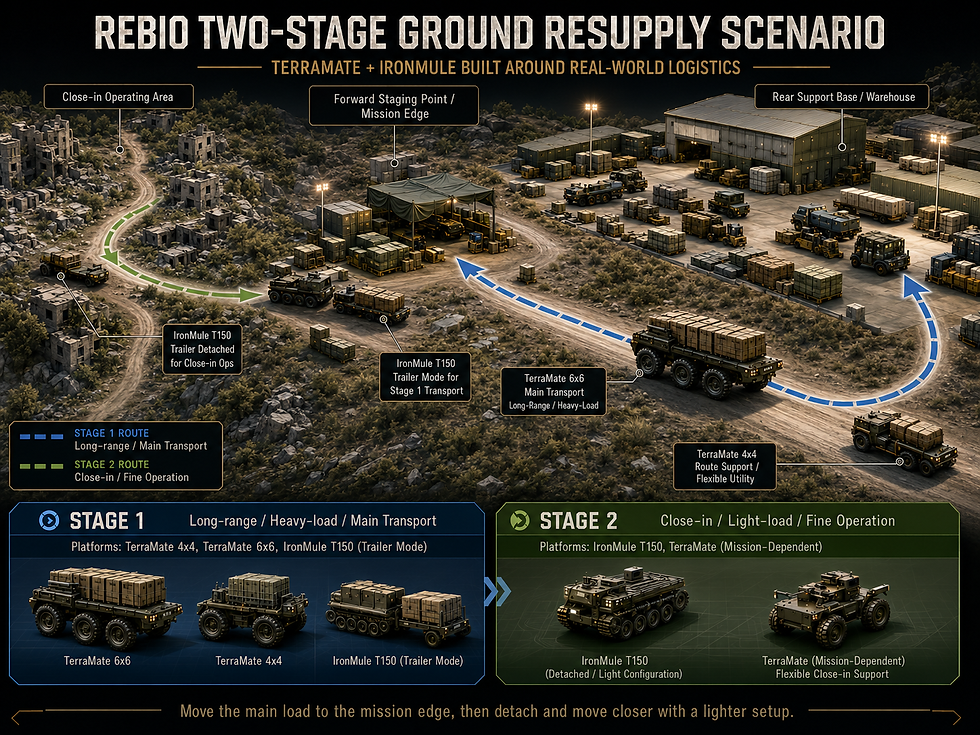
A complete unmanned ground system can be understood in three parts. Remote control, navigation and autonomy form the brain. Mission equipment forms the upper limbs. The chassis, propulsion, suspension, energy system and mobility architecture form the lower body. Without a reliable lower body, advanced software cannot deliver supplies to their destination. REBIO GROUP’s TerraMate and IronMule product lines are structured around this division of missions. TerraMate is designed for higher mobility, heavier payloads, longer operating distances and more complex mission integration. IronMule is intended for tracked mobility, close-in operations, towing and scalable deployment. They are not high- and low-end versions of the same vehicle. They are complementary unmanned ground vehicle platforms for different stages of a mission. This logic supports a two-stage logistics model. In the first stage, the principal load is transported toward the mission edge. In the second stage, equipment is detached, redistributed or reconfigured, allowing a platform better suited to confined or damaged terrain to move closer to the operational area. On a sensor-dense battlefield, the most important vehicle specifications are not limited to top speed and rated payload. They also include repairability, communications compatibility, autonomy-system integration and the ability to adapt mission payloads locally.
Why Fiber Optic Is Becoming Part of the Unmanned System’s Nervous System
If Hyper War is defined by the speed of the information cycle, communications infrastructure is no longer a background utility. It is part of the operational system. In June 2026, NATO’s senior military commander, US Air Force General Alexus Grynkewich, said modern warfare was fundamentally about data: the side that moves data faster and applies more effective algorithms can use its available systems more effectively. Wireless communications remain indispensable. But in high-interference environments—and within vehicles, fixed command nodes, radar systems, sensor arrays and electronic equipment—fiber optic links provide another critical layer of connectivity. Their value is not limited to bandwidth. It also includes resistance to electromagnetic interference, signal stability, reduced weight and environmental reliability. REBIO’s industrial fiber optic portfolio includes aerospace and aviation optical cables, high-temperature and radiation-resistant optical cables, high-density connectors, expanded-beam connectors, active optical network products and RF-over-fiber modules. The product range also includes ruggedized data-bus cables, network cards, interface-processing modules and optical distribution systems designed for demanding aerospace and industrial environments.

These products should not be interpreted as evidence that they have been deployed in Ukraine, nor as proof that a particular module has already been integrated into a TerraMate or IronMule platform. But they illustrate a clear engineering direction. As an unmanned ground vehicle connects cameras, radar, computing systems, mission payloads and control equipment, fiber optic cables, connectors, data buses and network modules may become critical enabling parts rather than peripheral accessories. In the era of drone warfare, public attention naturally focuses on visible platforms. The components that allow those platforms to exchange data reliably are far less visible—but often equally important.
A Supply-Chain Advantage Can Also Become a Strategic Vulnerability
Ukraine’s drone industry has demonstrated the value of rapid innovation. It has also exposed the risks created by concentrated supply chains. The Guardian reported that Ukraine had moved from importing large numbers of complete systems toward domestic assembly and local component production. Even so, full independence from Chinese supply chains remained difficult, particularly in batteries, rare-earth magnets and electronic components. This is a familiar industrial contradiction. A mature supply chain lowers cost, accelerates prototyping and supports volume production. But when export controls, trade disputes, logistics interruptions or political relations change, concentration can quickly become a strategic risk. The same logic applies to software. In July 2026, Ukrainian officials said the country would prioritize AI models that could run on domestic servers, reducing the risk that an external provider might restrict or disable a critical system. Ukraine had also announced plans to build domestic AI computing infrastructure. The first stage was expected to require 3 to 5 megawatts of computing capacity and tens of millions of dollars in investment, partly because military data and models could not remain permanently dependent on infrastructure outside the country. The conclusion is the same across components, data and algorithms: Having the right to use a system is not the same as having the capacity to keep it running.
Why the KD Model Must Transfer Capability, Not Just Components
For UGV programs, KD is often understood as shipping parts abroad for final assembly. In the environment created by drone warfare and Hyper War, that definition is no longer sufficient. An effective UGV KD system should include:
product definition based on mission, terrain and payload;
supplier management and diversified sourcing;
tools, fixtures and assembly procedures;
testing standards and quality assurance;
software and hardware version traceability;
technical training and fault diagnosis;
regional spare-parts inventories;
mission-payload and communications integration;
field feedback and rapid product improvement.
KD should transfer part of the capacity to adapt and improve—not merely the labor required to tighten bolts. REBIO has applied similar industrialization methods in earlier overseas solar-factory and IVD laboratory programs. Those projects combined factory planning, production equipment, supply-chain coordination, training, quality control and long-term operational support. Its solar industrialization program included an overseas project with approximately $8.5 million in investment, a planned photovoltaic manufacturing structure of about 1.6 GW and an initial 600 MW module line in operation from September 2017. Its IVD program involved approximately €1.3 million in investment and a semi-automated rapid-test assembly line rated at 3,000 units per hour. Local production does not eliminate trade conflict. It can, however, reduce dependence on uninterrupted cross-border shipments of complete products and shorten recovery time when supply conditions change. REBIO is applying this industrialization approach to the UGV sector. Chinese manufacturing and supply-chain capabilities provide mature platforms, engineering support and critical components. Local partners contribute market access, autonomy software, mission payloads, regulatory knowledge, final assembly and field service. The KD system connects these capabilities into a regional structure that can deliver, maintain and upgrade products over time. TerraMate and IronMule can therefore function not only as vehicles for direct sale, but also as mobility platforms on which local defense groups, system integrators and autonomy companies can build their own solutions.

Beyond Drone Warfare: The Real Unit of Competition Is a System
Drones will remain one of the defining technologies of modern conflict. But drone warfare is not a world built by drones alone. It requires sensors to observe, networks to move information, algorithms to interpret change, ground platforms to transport supplies, fiber optic and other communications components to maintain connectivity, and factories and maintenance teams to replace losses. The true unit of competition is shifting away from a single drone, a single unmanned ground vehicle or a single software package. It is becoming a complete technical and industrial system: Platforms + data + communications + energy + maintenance + supply chains + iteration speed. That may be the most important lesson other countries can draw from Ukraine. The objective is not simply to copy a particular drone design or assume that enough robots can solve every operational problem. It is to build a mechanism that can learn from the field, modify products quickly, expand production and maintain systems over time. For defense groups and system integrators evaluating local UGV assembly, military fiber optic systems, regional service centers or KD factories, the most valuable partner may not be the company offering a single piece of equipment. It may be the company capable of converting mature industrial capacity into durable local capability.


Comments