
All-Terrain
Unmanned Ground Vehicle
Platforms
1,000+
REBIO UGVs are in service worldwide
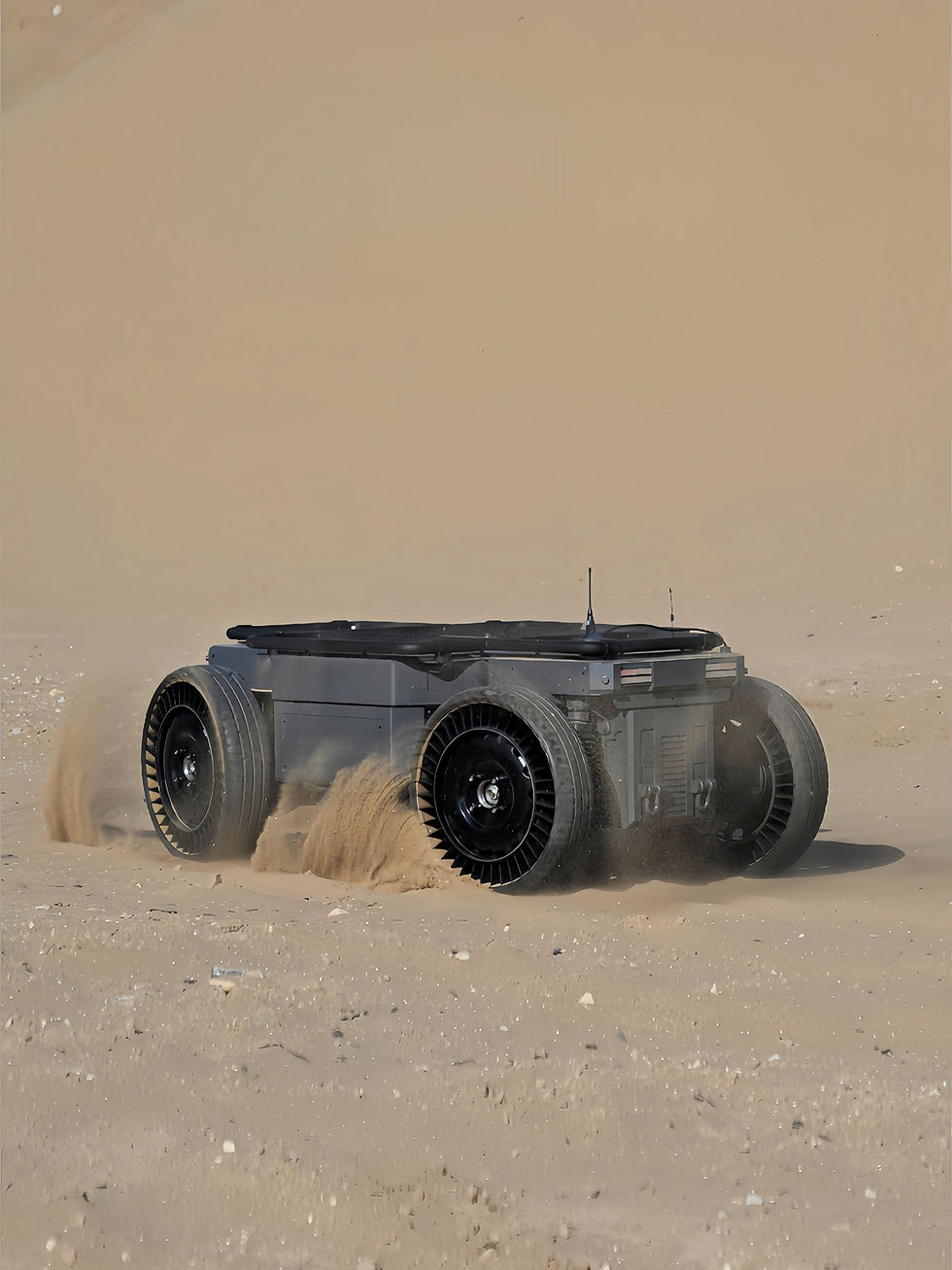
REBIO TerraMate is a high-performance Unmanned Ground Vehicle (UGV) platform architecture built for rough terrain, rapid deployment, unmanned logistics, emergency response and mission-critical mobility.
For qualified projects, TerraMate is not only a vehicle platform. It is a field mobility base for logistics, sensors, mobile power supply, emergency response modules and unmanned mission payloads.

Four-Wheel Independent Suspension & Drive-by-Wire Chassis
This ensures exceptional all-terrain stability and payload protection by isolating vibrations on complex terrains. The drive-by-wire system provides high-precision digital control, enabling seamless integration with advanced autonomous driving algorithms.

Electronically Controlled Torsen Differential
Electronically controlled torque distribution improves traction when wheel grip varies across loose soil, mud, sand and uneven terrain. By dynamically transferring torque to wheels with better traction, the system improves mobility, stability and controllability under demanding off-road conditions.

Dual-Redundancy Power System
By providing a fail-safe backup for the propulsion system, it significantly enhances mission continuity and vehicle survivability. This redundancy minimizes the risk of operational failure during critical, high-stakes deployments.

Ultra-Wide Operating Temperature Range
Engineered to withstand extreme climates, this feature guarantees reliable performance from arctic cold to desert heat, from -30℃ to +70℃. It ensures it is mission-ready in any geographic environment without compromising hardware integrity.

Modular Body Design & Battery Swapping Solution
The modular architecture allows for rapid mission reconfiguration, while the battery swapping system enables near-zero downtime for energy replenishment. This combination maximizes operational efficiency and fleet utilization rates.

Multi-Link Redundant Communication & Military-Grade Frequency Hopping
It provides a robust, anti-jamming communication link, that ensures secure and stable data transmission over a range of up to 10Km of contested electronic environments. This safeguards remote command and control against signal interference or interception.
TerraMate platforms are high-performance mobile power platforms for rough terrain, unmanned logistics, emergency response, and third-party payload or autonomy integration.
TerraMate 4x4 is optimized for compact mobility and payloads from 500 kg, with driving range from 150 km. TerraMate 6x6 supports payloads from 800 kg, higher speed, and demanding medium-class logistics missions.
TerraMate 4x4 and TerraMate 6x6 are all-terrain UGV platforms built for field logistics, CASEVAC support, CBRNe payload integration and remote operations in harsh terrain.
Both platforms use REBIO electric-intelligent mobility technologies, including drive-by-wire chassis control, electric drive assemblies, vehicle control units, hybrid power, and modular payload integration.
Share your payload, terrain, driving range, control distance, GNSS-denied operation requirement, mission module, quantity, delivery schedule and KD/CKD or local assembly needs. Our team will recommend a suitable TerraMate platform and integration approach.
TerraMate 4x4 | TerraMate 6x6 | |
|---|---|---|
Drive type | Wheeled | Wheeled |
Dimension | ≤ 2700x1500x1000mm | ≤ 2400x1600x1350mm |
Powertrain | Hybrid | Hybrid |
Curb weight | ≤ 850 Kg | ≤ 1700 Kg |
Rated payload weight | ≥ 500 Kg | ≥ 800 Kg |
Max speed | ≥ 40 Km/h | ≥ 60 Km/h |
Max ground clearance | 220 mm | 170 mm |
Trench passing ability | 300 mm | 600 mm |
Fording depth | 350 mm | 400 mm |
Max grade | ≥ 60 % | ≥ 70 % |
Step climb | 220 mm | 450 mm |
Driving distance | ≥ 150 Km | ≥ 110 Km |
30%-80% fast charge (DC) time | ≤ 1 h | ≤ 0.5 h |
Turning radius | ≤ 4.5 m | 0 m |
Environmental adaptability | -25°C~+55°C | -30°C~+55°C |
Protection rating | IP 67 | IP 67 |
Suspension | Rigid axle suspension | Independent suspension |
Tire | 205/70R15 | 235/75R15LT |
OTA remote upgrade | Y | Y |
Horn | Y | Y |
Hill start/Anti-rollback | Y | Y |
Emergency stop button | Y | Y |
Remote controller | Y | Y |
Ancillary fuel tank | O | O |
Inverter (External power supply) | O | O |
Non-pneumatic tire | O | O |
DC fast charging module | O | O |
Wireless charging module | O | O |
Max speed upgrade | O | O |
Follow-me kit | O | O |
Autonomous driving kit | O | O |
Polar Version | * | * |
Equatorial Version | * | * |
Notes:
1. “Y” indicates standard features, “O” indicates optional features and “*” indicates customization is available.
2. The data and images on this page are for reference only and are not intended to be used as a legal basis for placing an order. Specific products and specifications are subject to order confirmation. REBIO GROUP reserves the right to change product specifications.


REBIO focuses on the development and integration of electric and intelligent vehicle systems, especially distributed drive control systems, drive-by-wire chassis, electric drive assemblies and vehicle control units.
These technologies allow REBIO to build unmanned mobility platforms from the chassis level, rather than simply modifying conventional vehicles.
REBIO’s core capabilities include:
-
Distributed electric drive control
-
Drive-by-wire chassis development
-
Electric drive assembly integration
-
Vehicle control unit development
-
Power and energy management
-
Steering, braking and suspension control
-
Modular payload interface design
-
Remote-control and autonomous-ready architecture
-
Harsh-environment vehicle integration
-
Field-maintenance-oriented platform design
REBIO UGV is built on two complementary platform lines: TerraMate premium wheeled UGVs and IronMule general-purpose tracked UGVs.
TerraMate is designed for long-range, high-speed, high-payload and complex mission integration.
IronMule is designed for cost-effective deployment, strong towing, rough-ground mobility and close-in field work.
REBIO supports platform adaptation, pilot deployment, spare-parts planning, operator training and regional localization for qualified UGV projects. This allows partners to move from product purchase to sustainable local deployment capability.
Open by design.
Compatible by mission.


Universal open-architecture chassis adapts to various payloads


Observer / patrol / fire-fighting
Explosive Ordnance Disposal (EOD)
Service support platform
Light mining machinery / light agricultural machinery
Rescue and transportation
UAV & Anti-UAV and robot dog platform
Cluster control center
IronMule Platform
IronMule T150 | IronMule T70 | |
|---|---|---|
Drive type | Tracked | Tracked |
Powertrain | Pure Electric | Pure Electric |
Dimension | ≤ 1085x900x420mm | ≤ 720x580x380mm |
Curb weight | 100 Kg | 50 Kg |
Working Payload | 70-150 Kg | 30-70 Kg |
Towing capability | ≤ 2.5 tons | NA |
Max speed | ≥ 10 Km/h | ≥ 10 Km/h |
Step climb | ≥ 150 mm | ≥ 180 mm |
Endurance | ≥ 4 hours/18 Km | ≥ 3 hours/20 Km |
Max grade | ≥ 35° | ≥ 30° |
Container loading quantity | 24pcs (20GP) / 54pcs (40HQ) | 42pcs (20GP) / 90pcs (40HQ) |
Remote controller | Y | Y |
Max speed upgrade to 20 Km/h | O | NA |
Follow-me kit | O | O |
Autonomous driving kit | O | O |
Trailer | O | O |
Notes:
1. “Y” indicates standard features, “O” indicates optional features and “NA” indicates not available.
2. The data and images on this page are for reference only and are not intended to be used as a legal basis for placing an order. Specific products and specifications are subject to order confirmation. REBIO GROUP reserves the right to change product specifications.


1
Simulation
-
Strength check
-
Vibration calibration
-
Temperature simulation
-
Immersion simulation
-
Life simulation
2
Design
-
Steering system
-
Suspension system
-
Powertrain system
-
Operating & control software
-
Hardware customization
3
Manufacturing
-
Small-batch trial production
-
Large-scale production
-
Military-grade quality control
4
Testing
-
Components bench verification
-
Vehicle integration testing
-
Vehicle condition verification
5
Delivery
-
CBU/KD model optional
-
Multimodal transport
Upcoming UGV Models


FAQ
-
Which TerraMate UGV platform should I choose: 4x4 or 6x6?
TerraMate 4x4 is designed for compact rough-terrain mobility and payloads from 500 kg, while TerraMate 6x6 supports payloads from 800 kg, higher speed, and more demanding mobility requirements. Final selection should be based on payload size, terrain, range, speed, power demand, and transport constraints.
-
Can TerraMate integrate third-party sensors, autonomous systems, or mission payloads?
Yes. TerraMate uses a modular, drive-by-wire platform architecture designed to support third-party sensors, communication equipment, navigation systems, autonomous-driving systems, robotic equipment, and other project-specific payloads. Interface, power, weight, and environmental requirements are reviewed for each project.
-
Does TerraMate support remote control and autonomous driving?
TerraMate can support remote-control, follow-me, and autonomy-ready configurations depending on project requirements. Final autonomous functions depend on the selected sensors, computing hardware, software, communications, and safety architecture.
-
Can TerraMate be used for logistics, emergency response, and industrial applications?
Yes. TerraMate platforms can be configured for field logistics, emergency response, hazardous-site inspection, firefighting support, energy and infrastructure inspection, smart agriculture, scientific exploration, and other demanding off-road applications.
-
Can REBIO provide KD local assembly and lifecycle support?
Yes. REBIO can discuss complete vehicle supply, platform supply, OEM/ODM cooperation, KD assembly, local adaptation, technical training, quality processes, spare-parts planning, and lifecycle support for qualified regional projects.
-
What information should I provide to request a technical proposal?
Please provide the application, payload weight and dimensions, terrain, target speed and range, operating temperature, communication and autonomy requirements, expected quantity, delivery location, schedule, and any local assembly needs.
What is UGV (Unmanned Ground Vehicle)?
An Unmanned Ground Vehicle (UGV) is a motorized, autonomous, or teleoperated vehicle that operates without an onboard human presence. Engineered to replace or augment human capabilities in hazardous, austere, or physically demanding environments, UGVs rely on a complex integration of drive-by-wire chassis systems, multi-sensor perception, and intelligent control algorithms. They are the cornerstone of modern ground-based automation, serving critical roles across defense, security, and specialized industrial sectors.
For buyers and system integrators, the most important UGV requirements are no longer only autonomy or appearance, but payload capacity, driving range, remote-control stability, terrain adaptability, maintenance efficiency and mission-module compatibility.


What is UGV Classifications & Typical Application Scenarios?
UGVs are highly versatile and can be categorized by their mobility mechanisms (wheeled vs. tracked) and payload capacities.
-
Light UGV (Max payload weight < 300Kg) Light UGVs are compact, agile, and rapidly deployable unmanned ground platforms designed for tasks that require high mobility, flexible deployment, and operation in confined or complex environments. Typical applications include patrol and observation, perimeter security, emergency response, reconnaissance support, light logistics, inspection, and small mission-module transport.
-
Medium UGVs (300Kg ≤ Max payload weight ≤600Kg) Medium UGVs represent the most practical and widely demanded payload range for all-terrain unmanned ground operations. They provide a strong balance between mobility, endurance, payload capacity, and cost efficiency, making them suitable as reliable Overland Robotic Teammates in harsh environments. Typical applications include last tactical mile logistics, equipment transport, casualty evacuation support, mobile drone launch and recovery, communication relay, CBRNe detection support, EOD support and multi-purpose mission payload integration.
-
Heavy UGVs (Max payload weight>600Kg) Heavy UGVs are high-capacity unmanned ground platforms built for large payloads, long-distance transport, and demanding off-road operations. With reinforced chassis structures, high-torque powertrains, and modular payload interfaces, they are designed to support mission-critical operations where conventional light platforms are insufficient. Typical applications include heavy logistics, engineering support, mobile energy supply, large sensor or communication payloads, field service platforms, disaster response, and specialized industrial or dual-use missions.
What is The Core Technologies Powering Modern UGVs?
-
Drive-by-Wire Chassis Integration: Eliminates mechanical linkages for digital control. Delivers millisecond-level precision for autonomous algorithms and extreme reliability.
-
Multimodal Perception (LiDAR + Vision + Radar): The "eyes" of the UGV. Ensures safe navigation, obstacle avoidance, and target recognition even in GPS-denied or low-visibility environments.
-
High-Density Energy & Power Management: Advanced hybrid or solid-state battery systems. Provides long operational endurance and "silent watch" capabilities, minimizing acoustic and thermal signatures.
-
Wide Operating Temperature Range: It requires state-of-the-art active thermal regulation systems, specialized military-grade components, and highly insulated, temperature-controlled battery architectures. UGV with Wide Operating Temperature Range can be deployed to most parts of the earth at any time for service, and can be started and operated continuously around the clock in various environments such as polar regions, plateaus, Gobi Desert and desert.
-
Military-Grade Encrypted Communication: Robust data links, redundant communication paths and frequency-hopping capability help maintain resilient command and control under interference, electronic warfare pressure and long-range remote-operation conditions.

Featured Insights


Video Gallery

UGV DAILY TESTING
See how REBIO UGV platforms are tested day after day—from braking, wading and obstacle crossing to full-load maneuvering—to validate reliability before deployment. Continuous testing is part of our engineering routine.

UGV APPLICATIONS
Explore REBIO UGVs in real-world missions, including firefighting support, logistics, towing and operations across demanding terrain. Proven mobility platforms adapt to different environments and mission-specific payloads.

POWERTRAIN BEYOND UGV
Explore how REBIO’s electric powertrain, vehicle-control and energy-management technologies extend beyond ground vehicles into USV, UAV and other unmanned mobility platforms—demonstrating a common engineering foundation across land, water and air.

CUSTOM UGVS
Discover mission-built UGV platforms developed around specific mobility, payload, control and system-integration requirements. Each custom project turns an operational need into a field-tested solution.
Photo Gallery


