Saudi East-West Pipeline Drone Attack: UGV-Based Security for Remote Oil Infrastructure

Updated: 2 hours ago
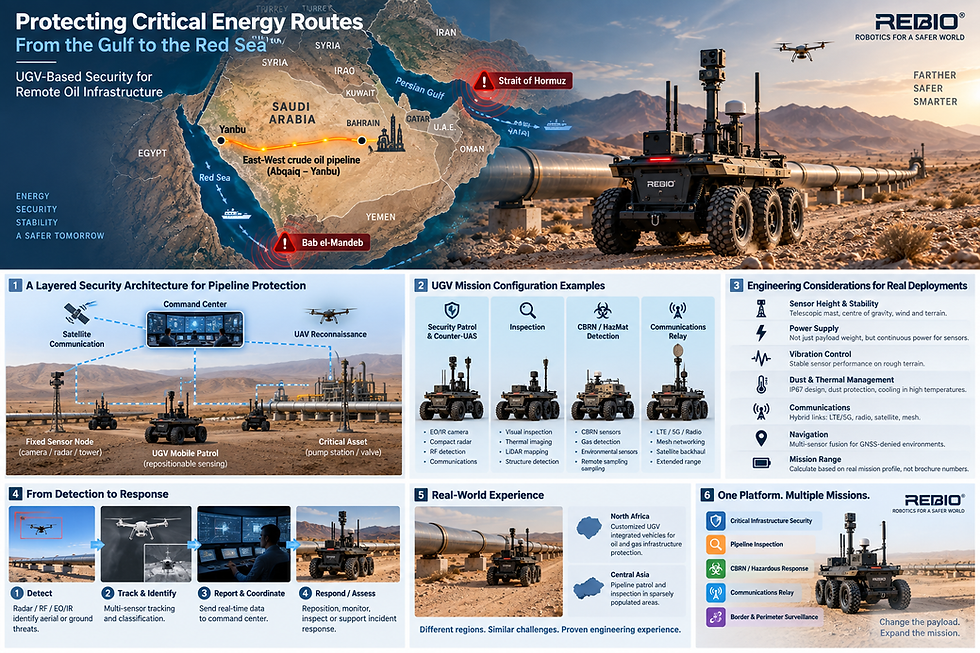
REBIO is currently supporting customized integrated UGV vehicle programs for projects in one North African country and one Central Asian country, both involving the protection, patrol and inspection of oil and gas infrastructure across sparsely populated areas. Client identities and detailed...
For decades, the Strait of Hormuz has dominated discussions about Gulf energy security. In September 2026, however, one of the most serious vulnerabilities shifted inland.
Saudi Arabia temporarily shut its East-West crude oil pipeline after drone attacks that Riyadh and Baghdad said originated in Iraq. The 1,200-kilometre line had been moving roughly 4–5 million barrels per day and had become a critical alternative route while shipping through the Strait of Hormuz remained heavily constrained. Reuters reported the shutdown and its strategic impact here.
The importance of that route was already clear earlier in 2026. Saudi Aramco reported that the East-West Pipeline had been ramped to its maximum capacity of 7.0 million barrels per day in the first quarter to support west-coast exports during shipping constraints around Hormuz. Aramco's Q1 2026 report documents that operating shift.
A refinery can be protected as a site. A terminal can be protected as a site. A pipeline stretching hundreds or thousands of kilometres through desert, steppe or other sparsely populated terrain is not a site. It is a corridor.
Protecting a corridor requires a different security architecture—one that can move sensors, communications and response capability to where the risk actually is.
The Security Problem Is Moving From Fixed Sites to Long Corridors
Conventional critical-infrastructure security is heavily based on fixed assets: fences, CCTV, access control, observation towers, perimeter radar and staffed security posts. Those technologies remain essential, but their weakness becomes visible when the protected asset extends over very long distances.
Installing sophisticated sensor packages continuously along an entire pipeline can become prohibitively expensive. Human patrols provide judgment and physical presence but involve recurring manpower costs, travel time and personnel exposure. Fixed systems are also inherently limited by location: once a radar, thermal camera or communications node has been installed, its coverage area is largely predetermined.
The protected pipeline is fixed. The threat is mobile.
The area of highest risk today may not be the highest-risk section tomorrow. This is where unmanned ground vehicles can contribute something that fixed infrastructure cannot easily provide: repositionable sensing and persistent ground presence.
A UGV Does Not Replace Counter-UAS — It Makes Part of the System Mobile
Counter-UAS protection around an oil terminal or refinery can often be designed around fixed sensor geometry. Pipeline protection is different. A properly configured UGV can carry and reposition an integrated package that may include electro-optical and infrared cameras, compact radar, RF-detection equipment, LiDAR, acoustic or environmental sensors, edge-computing hardware and communications equipment.
The operational chain is straightforward: Detect → Track → Identify → Report → Coordinate.
The UGV provides mobility, power, payload capacity and interfaces. Specialist counter-UAS equipment performs the sensing and target-management functions for which it was designed. The engineering value comes from integrating those layers correctly rather than treating the ground vehicle itself as the entire counter-drone system.
For oil and gas infrastructure, this can turn a fixed sensor into a repositionable observation post. A platform can patrol a defined section of pipeline, stop at a designated monitoring position, deploy its sensor package, remain on station, transmit data to a control centre and later move to another area as the risk picture changes.
Fixed Sensors, UAVs and UGVs Should Work Together
The correct question is not whether a pipeline operator should choose UAVs or UGVs. Each platform sees the problem from a different position. UAVs are useful for rapidly covering long distances, inspecting rights of way, locating visible damage and responding quickly to an alert. UGVs provide heavier payload capacity, more continuous electrical power, persistent ground presence and close-range access to valves, pump stations, manifolds and damaged pipeline sections.
This layered approach is already visible in infrastructure inspection. INPEX and Mitsubishi Heavy Industries demonstrated long-distance autonomous UAV patrol along a Japanese natural-gas pipeline and described a broader networked system linking aerial, ground, surface and underwater unmanned vehicles for infrastructure inspection and surveillance. MHI's demonstration details are available here.

A resilient architecture is therefore better understood as: Fixed Sensors + UAV + UGV + Command Centre. Fixed assets maintain continuous watch over known critical points; UAVs provide rapid wide-area reconnaissance; UGVs provide persistent mobile sensing, equipment transport and close-range assessment.
The Difficult Part Is Not Mounting a Camera on a Vehicle
Pipeline-security projects quickly become systems-engineering projects. The practical challenges start when mobility, sensors, power, communications and autonomy have to operate together continuously in dust, heat, vibration and weak-network environments.
Sensor Height Versus Vehicle Stability
Radar and electro-optical sensors generally benefit from increased height because line of sight improves. A telescopic or deployable mast can help, but raising a sensor package changes the vehicle's centre of gravity and increases sensitivity to wind, slope and vibration. A mast that works perfectly on level concrete may behave very differently on loose desert soil or an inclined pipeline service road.
The design therefore needs to distinguish between mobile sensing, where equipment operates while the UGV is moving, and stationary observation, where higher or more sensitive equipment can be deployed after the platform stops.
Payload Weight Is Only Half of the Power Equation
UGV specifications frequently focus on kilograms of payload. For sensor-intensive applications, that is incomplete. Radar, EO/IR systems, RF receivers, edge computers, communications equipment, cooling systems and auxiliary electronics all consume electrical power.
System integrators therefore need to ask two separate questions: How much payload can the vehicle carry? And: How much continuous electrical power can the platform supply to that payload under real operating conditions?
This becomes especially important during stationary surveillance, when propulsion demand may fall but the complete sensor suite remains active for extended periods. A pipeline-security UGV is therefore also a mobile power architecture.
Vibration Control and Sensor Performance
Pipeline routes are rarely smooth laboratory surfaces. Gravel roads, sand, washboard surfaces, rocks and damaged tracks transmit vibration into the vehicle. That matters because an expensive camera or radar does not deliver its theoretical performance if the mounting structure is continuously oscillating. Suspension, equipment isolation, mast stiffness and sensor mounting therefore become part of the surveillance system itself.
Dust and Thermal Management
In North Africa, the Middle East and large parts of Central Asia, dust can be at least as important as rain. An IP67-rated enclosure provides an important baseline, but a complete vehicle also contains components that generate heat and may require cooling paths, protected connectors and careful thermal management.
High ambient temperature further complicates the problem. Sensors, computers, radios, power electronics and batteries all generate heat simultaneously. A vehicle expected to remain stationary under desert sun while operating a complete surveillance payload may face a very different thermal load from a lightly equipped vehicle driving continuously.
Communications May Be the Real Constraint
Remote oil and gas infrastructure often passes through exactly the locations where commercial network coverage is weakest. A sophisticated UGV therefore cannot assume that conventional cellular service will always be available. Depending on the project, communications architecture may combine private LTE or 5G, radio links, mesh networking, satellite backhaul or relay nodes.
This creates another role for the vehicle itself: the UGV can carry a mobile communications relay, allowing operators to reposition not only sensors but also part of the communications infrastructure.
Navigation Beyond Perfect GNSS Coverage
Pipeline corridors may cross valleys, industrial areas, terrain with poor satellite geometry or locations where GNSS availability is degraded. LiDAR, inertial navigation, wheel odometry and onboard perception can provide additional localisation inputs. The appropriate autonomy level varies by project—from waypoint patrol with remote supervision to primarily teleoperated vehicles with autonomous obstacle avoidance or third-party autonomy stacks integrated onto an open drive-by-wire chassis.

Driving Range Must Be Calculated as a Mission Radius, Not a Brochure Number
A vehicle advertised with 150 km of driving range does not automatically provide a 150 km pipeline patrol sector. The real mission has to account for return distance, terrain, detours, auxiliary electrical load, temperature, payload mass, stationary observation time and the energy reserve required when something goes wrong.
For remote infrastructure, reliability planning should therefore be based on mission energy rather than catalogue range. A UGV that stops in a city can be recovered easily. A UGV that stops 60 kilometres into an unmanned desert corridor becomes a logistics problem of its own.
This Is Already Becoming a Real Engineering Requirement
This is not a hypothetical application for REBIO.
REBIO is currently supporting customized integrated UGV vehicle programs for projects in one North African country and one Central Asian country, both involving the protection, patrol and inspection of oil and gas infrastructure across sparsely populated areas. Client identities and detailed configurations remain confidential, but the projects share several recurring requirements: long-range ground mobility, multi-sensor integration, reliable onboard power, remote communications, harsh-environment operation and sufficient payload margin for mission-specific equipment.
These projects have reinforced one practical conclusion: the more sophisticated the mission payload becomes, the more important the reliability of the vehicle underneath it becomes.
This Is Where an Open All-Terrain Platform Matters
REBIO's TerraMate architecture is intended to provide the mobility layer beneath these kinds of mission systems. The current TerraMate 4×4 platform supports rated payloads from 500 kg and driving range from 150 km, while TerraMate 6×6 supports payloads from 800 kg and driving range from 110 km. Both are specified at IP67 and are designed for third-party sensors, communications equipment, navigation systems and project-specific mission payloads. Full specifications are available on REBIO's open all-terrain UGV platform page.
Those figures are useful because they create integration margin. A sensing package, deployable mast, communications system, onboard computer, backup power hardware and environmental sensors consume both weight and space. Once those systems are integrated, the platform still needs enough reserve capacity to retain useful mobility.
REBIO's development approach is based on a relatively small number of core UGV platforms that are repeatedly tested and adapted rather than designing a completely new vehicle for every new mission. This is the same logic discussed in our analysis of UGV reliability testing: sensors can change, communications systems can change and autonomy software will change, but the underlying vehicle still has to start, move, climb, brake, communicate and return.
Reliability remains the first layer of autonomy.
Counter-Drone Security Is Only the First Half of the Mission
The security mission does not necessarily end when an incoming drone disappears from the radar. If an attack reaches a pipeline, pumping station or associated industrial facility, the ground problem may only be beginning.
There may be fire, a hydrocarbon leak, toxic gases, damaged electrical equipment, secondary explosion risk or an environment that responders cannot immediately classify. In those conditions, sending personnel directly to the suspected impact point may create unnecessary exposure.
The same UGV that previously carried surveillance equipment can be reconfigured with thermal cameras, gas detectors, environmental sensors or CBRN detection equipment and sent forward for initial assessment. This is where REBIO's existing UGV + CBRNe payload integration experience becomes directly relevant.
The mission cycle becomes: before an incident—patrol, sensing and anomaly detection; during an incident—remote observation and situational awareness; after an incident—hazardous-area inspection, gas or CBRN assessment and emergency support.
Oil Pipelines and Borders Share the Same Geometry
The same engineering principle also explains why UGVs are increasingly relevant to remote border and perimeter surveillance. An oil pipeline and a national border are different politically and operationally, but from a mobility-and-sensing perspective they share an important characteristic: both are long linear corridors with changing risk points and limited permanent human presence.
Both require persistent observation, both contain areas where fixed sensors alone may leave gaps, and both may require temporary reinforcement of a particular sector. This does not mean one configuration fits every mission. It means the same open ground platform can support different mission payloads without requiring a completely new vehicle architecture each time.
From the Strait of Hormuz to the Desert Pipeline
The current Middle East crisis is demonstrating how strongly global energy systems depend on a relatively small number of routes. Earlier REBIO analysis of ground robotics for port security around the Strait of Hormuz examined how maritime disruption transfers operational pressure ashore. The East-West Pipeline attack now shows the other side of that equation: bypass infrastructure must itself be protected.
As of September 14, the pipeline outage was threatening to remove roughly 4% of global oil supply while the region was already facing shipping constraints. Reuters' latest assessment describes the scale of the supply risk.
That does not mean every kilometre of pipeline needs a sophisticated unmanned vehicle. It means infrastructure operators need another layer between fixed surveillance and human response.
For many remote oil and gas corridors, a properly engineered UGV can provide that layer. Its value is not simply that it is autonomous. Its value is that it can carry the required sensors, provide power, move them to the required location, remain there, communicate what it sees and enter places where sending people first may no longer be the safest option.
Protect the corridor, not only the site.
FAQ: UGV Pipeline Security
Can UGVs be used for oil pipeline security?
Yes. UGVs can patrol remote pipeline corridors and carry EO/IR cameras, radar, RF detection, LiDAR, communications and environmental sensors. Their main advantage is mobility: sensors can be repositioned along the pipeline instead of remaining permanently fixed at one location.
Can a UGV function as a counter-drone platform?
A UGV can serve as the mobile ground layer of a counter-UAS architecture by carrying detection, tracking, identification and communications equipment. The final counter-UAS configuration depends on the selected third-party system, local regulations and project requirements.
Why use UGVs instead of drones for pipeline patrol?
UAVs provide fast aerial coverage, while UGVs can carry heavier payloads, provide more onboard energy, remain at a location for extended periods and conduct close-range inspection. For long pipelines, the two technologies are complementary rather than interchangeable.
What specifications matter when selecting a UGV for pipeline security?
Key requirements include driving range, payload capacity, terrain capability, environmental protection, continuous payload power, communications, autonomy interfaces, sensor integration, maintenance requirements and recovery planning.


Comments