As Taser Reaches Farther, Why Frontline Policing Still Cares About “the Last Six Meters”?
- Richard Geng

- Apr 13
- 6 min read

Taser is pushing the global less-lethal market into a more expensive, more complex, and more heavily scrutinized phase. In 2025, Axon generated $2.8 billion in revenue, up 33% year over year, while its connected devices segment — including TASER 10, body-worn cameras, training systems, and counter-drone solutions — rose 38% in the fourth quarter alone. Taser is no longer just a device. It is increasingly a public-safety platform built around training, data, accountability, and budget architecture.
1. Taser’s rising profile shows the market is rewarding systems that are farther-reaching, more capable, and more integrated
It is not hard to see why TASER 10 has become the center of this debate. According to Axon, the device offers a maximum range of 45 feet and can deploy up to 10 individually aimed probes without reloading, with the stated goal of giving officers more time and distance to de-escalate an encounter. British official medical assessments describe TASER 10 as a meaningful break from earlier models: it extends engagement distance to 13.7 meters and changes the firing logic by shifting more of the outcome onto the operator’s ability to achieve effective probe placement.
From the market’s perspective, investors have clearly embraced that direction. Reuters reported that Axon shares surged more than 19% after its latest results, as the company benefited from strong demand for both security devices and software. The market is no longer rewarding Taser as a stand-alone tool. It is rewarding an ecosystem.
But that is also where the tension begins.

2. The more advanced Taser becomes, the more frontline users reprice simplicity and reliability
2.1 Greater range does not automatically mean lower operational complexity
The UK’s SACMILL assessment is unusually clear on this point. TASER 10 may shoot farther and carry more probes, but it still requires at least two probes to complete an effective circuit, and those probes must penetrate the skin to achieve neuromuscular incapacitation. At the same time, TASER 10 no longer offers a contact mode — formerly known as drive-stun — which earlier devices retained as a close-range fallback. The British assessment explicitly notes that this creates a capability gap relative to earlier generations.
That matters because procurement teams are not only comparing maximum range. They are also weighing training time, error tolerance, close-contact contingencies, after-action scrutiny, and compatibility with the systems they already use.
2.2 The more accountability matters, the more product logic gets reordered
Official statistics for England and Wales show 812,449 police use-of-force reports in the year ending March 31, 2025, up 9% from the prior year. The data does not prove overuse of any one tool. What it does show is that policing is operating under increasingly dense layers of documentation, review, and institutional accountability. In that environment, buyers care not only about what a device can do at its theoretical limit, but whether it is stable, intuitive, easy to train on, and easy to fit into existing workflow.
This is why the next stage of competition is no longer simply about who can build “something like Taser.” It is about who understands what frontline users are actually willing to buy.
3. A3 matters not because it copies Taser, but because it answers a different question
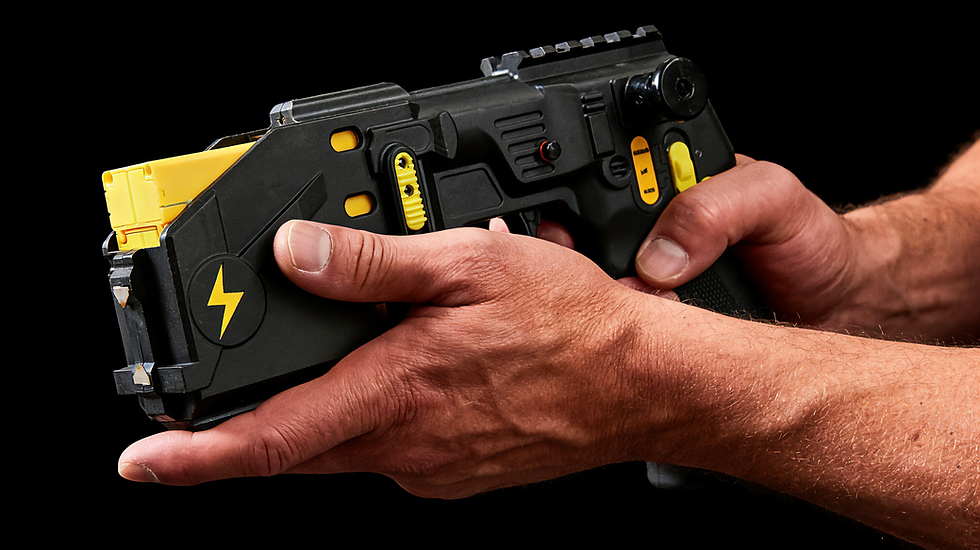
Viewed in that context, REBIO’s A3 Instant Subduer becomes easier to understand. It does not follow the “make it farther, make it denser, make it more integrated” logic all the way to its end point. Instead, it appears to answer a more practical question: within the 5-to-7-meter band where many real confrontations still unfold, what are officers least willing to lose?
According to the product brief, A3 uses a triple-shot design, offers an effective range of 5 meters and a maximum range of 6.8 meters, supports continuous discharge for more than 20 minutes, weighs about 398 grams, retains contact stun capability, and includes dual MIL-STD-1913 rails on the body.
Those figures may not look flashy on paper. In operational terms, however, they map directly onto three expensive and persistent problems: battery anxiety, close-contact control, and system compatibility.
4. A3’s advantage over Taser comes less from marketing language than from frontline feedback
4.1 Twenty minutes of continuous discharge addresses not just capability, but confidence
According to the customer feedback, A3 was refined through consultation with police forces across 30 provinces in China and went through five rounds of iteration before finalization. That matters because it suggests the product was not designed to impress on a specification sheet. It was designed to get as close as possible to what frontline users actually consider usable in the field.
The most telling example is endurance. A3’s ability to sustain discharge for more than 20 minutes is not just a technical feature. It addresses a real operational concern: officers do not want to carry multiple expensive and heavy spare batteries for a less-lethal device, and they do not want to calculate remaining power under pressure. A3’s longer-duration logic is therefore less about headline performance than about removing one category of anxiety altogether.
4.2 Retaining contact stun preserves a capability TASER 10 deliberately left behind
This is where the comparison becomes especially sharp. Official UK assessments state that TASER 10 no longer includes contact mode, creating a clear break with earlier devices. For many operators, that is not a marginal omission. It is the loss of a last-resort option in cramped spaces, physical struggles, and close-contact encounters where probe deployment may no longer be the optimal answer.
A3, by contrast, retains contact-type electric shock capability. Its significance is not that it revives an older tactical philosophy. It is that it acknowledges a simple operational truth: the most dangerous moments in policing do not always happen 13.7 meters away. Often, they happen in the last step or two. In those moments, a contact capability can provide a one-strike control option that protects the officer, shortens the encounter, and reduces the chance that the situation escalates further.
4.3 No built-in recorder is not a downgrade if the real objective is compatibility, weight, and mission focus
In today’s public-safety market, many products aim to integrate recording, illumination, communications, and evidence capture into one sealed package. But that approach comes with a practical obstacle: different law-enforcement agencies often run different information systems, evidence platforms, and documentation standards. A closed built-in recording system can therefore mean more weight, more cost, and less compatibility.
A3 takes a different approach. Instead of embedding a recorder, it uses two MIL-STD-1913 Picatinny rails that allow officers to mount an external body camera or tactical light based on agency requirements, field conditions, and personal working habits. That design choice effectively redirects weight, cost, and battery capacity toward the core mission, while leaving agencies free to use the recording and lighting systems they already trust. In procurement terms, that kind of openness can matter more than a built-in feature list.
5. Taser defines the category, but it does not define every order
Taser remains the strongest keyword in this segment because it has defined the category’s technical direction, market language, and procurement imagination. Axon’s growth shows that the high-end, platform-based route remains commercially powerful.
But at the same time, Taser’s own evolution is lighting up a different type of demand: institutions that do not necessarily need the longest reach or the most elaborate integration, but care deeply about continuous operating confidence, close-range backup control, lighter carry weight, open mounting options, training simplicity, and lifecycle cost.
That is where A3 appears to be most intelligently positioned. It is not trying to win by becoming a copy of Taser. It is positioning itself in the space Taser leaves behind.
Not by proving it can reach farther,but by proving it may fit real field conditions better in the last six meters.

6. Conclusion: Taser’s next competitive frontier may not be “farther.” It may be “more appropriate”
Taser’s story is not ending. Axon has already shown that less-lethal equipment can be built into a high-growth, high-valuation public-safety platform.
But platformization does not mean every procurement decision will move in the same direction. The more pressure agencies face on budgets, training, reporting, and interoperability, the more they will return to basic questions: Is it light enough? Is it dependable enough? Is it intuitive enough? Is it durable enough? Is it still effective in close quarters?
Taser may still represent the most visible upper bound of the category.But products like A3 may represent where the next layer of actual orders is made.
Because in the field, what determines success is often not the farthest shot on the brochure. It is whether the device fails the user in the last six meters.


Comments