China's CE-25A Electric Aircraft: Safety, Energy Density, Cooling and the Engineering of Reliability

On November 14, 2026, COMAC's CE-25A electric commercial aircraft completed its first piloted intelligent flight in Binzhou, Shandong Province, China. Powered by ten distributed electric ducted-fan propulsion units, the aircraft represents a significant step toward validating electric propulsion in a larger commercial aviation platform. Yet the more consequential question is not simply whether an electric aircraft can fly. It is how engineers can reconcile safety, weight, energy density, propulsion efficiency, thermal management and operational reliability within the same constrained system.
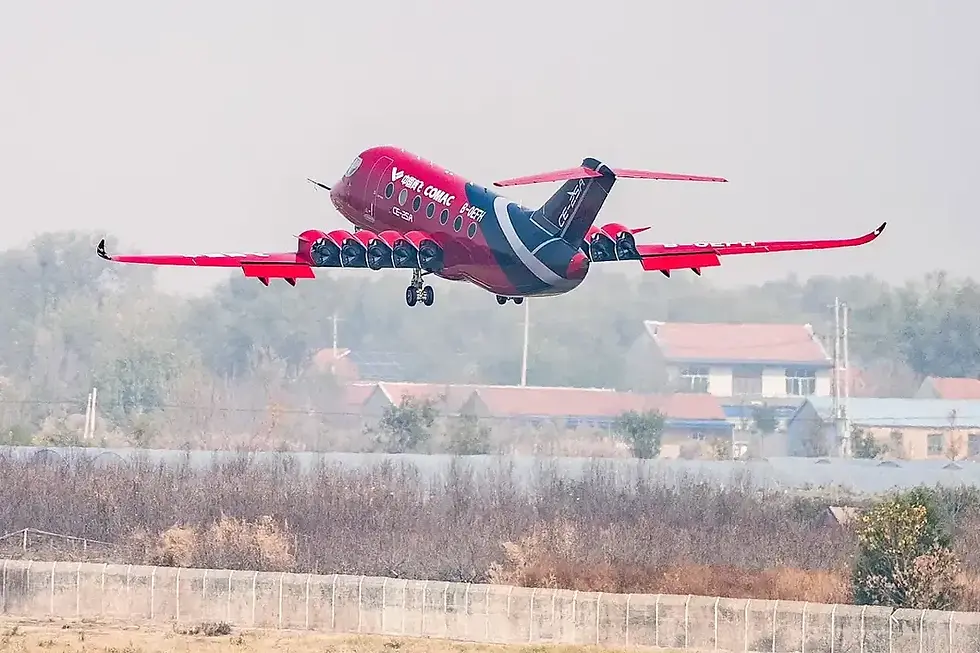
Designed for regional operations, the CE-25A has a planned capacity of 19 passengers, a maximum takeoff weight of approximately 10 tonnes and a design range of 400 kilometres. According to the Chinese Academy of Sciences' Institute of Electrical Engineering (IEE), its ten propulsion units provide a combined rated power of 2 megawatts, with a reported propulsion-system flight-profile energy efficiency of up to 94.5%. These figures demonstrate the potential of distributed electric propulsion, but they do not mean that the aircraft has completed commercial certification. Its first piloted flight involved 16 minutes and 38 seconds in the air, covering 60.4 kilometres; the widely reported 400-kilometre range remains a design target rather than a distance demonstrated during that flight.
From an engineering perspective, the CE-25A's significance extends beyond replacing combustion engines with electric motors. Electrification forces designers to reconsider a longstanding systems problem: how to deliver greater useful performance from limited mass, volume and available energy while keeping failure risks within acceptable boundaries. That challenge is central to aviation, but it is equally relevant to industrial mobile robotics, unmanned ground vehicles (UGVs) and other electrically driven platforms intended for demanding environments.
1. The “25” in CE-25A: Why Safety Standards Matter More Than a First Flight
The designation CE-25A contains an important clue to the aircraft's engineering ambitions. In COMAC's naming explanation, the number “25” refers to China's CCAR-25 airworthiness requirements for transport-category airplanes. While its distributed propulsion system is the aircraft's most visible innovation, this reference to the certification framework is arguably more revealing. Developing a transport-category aircraft is not merely about demonstrating that it can take off and land; it is about establishing, through analysis and evidence, that critical systems can meet the applicable safety requirements across defined operating conditions.
Modern aviation safety engineering relies on systematic hazard identification, failure classification and risk mitigation. Designers must understand which failures could reduce safety margins, which could compromise continued safe flight, and how combinations of failures could affect the aircraft. In established transport-aircraft system safety practices, catastrophic failure conditions are commonly associated with quantitative probability objectives on the order of 10⁻⁹ per flight hour. This is a safety assessment objective for particular failure conditions, not a direct prediction of an aircraft's overall accident rate. Nor does the number “25” imply that the CE-25A has already obtained certification. Its type certificate application has been accepted by the Civil Aviation Administration of China, while demonstration of compliance remains part of the certification process.
The practical importance of such a framework is that it reshapes the development process itself. Engineers must identify potential failure mechanisms, understand how failures might propagate through interconnected subsystems, and evaluate the effectiveness of proposed protective measures. Testing therefore serves a purpose beyond demonstrating performance: it challenges design assumptions, generates evidence and progressively reduces uncertainty before the product enters service.
The same engineering philosophy is relevant to unmanned ground vehicles, even though their operating risks and regulatory obligations differ fundamentally from those of passenger aircraft. An unmanned vehicle operating in a desert, remote industrial facility or hazardous-response environment may not carry passengers, but an unexpected breakdown can still interrupt a critical operation, immobilize valuable equipment or require personnel to enter dangerous terrain. Reliability in these environments cannot be established through a single obstacle-crossing demonstration, a short high-speed run or an impressive static specification sheet.
For REBIO GROUP's TerraMate unmanned ground vehicle platforms, a defined development requirement is that each version undergo at least 5,000 kilometres of road testing across different terrain conditions before market release.
Extended road trials expose the drivetrain, suspension, steering assemblies, structural connections and vehicle-control system to repeated vibration, shock and changing loads. Some defects are difficult to identify during brief prototype demonstrations but emerge progressively through extended operation, including mechanical fatigue, loosening connections, sensor drift, accumulated heat and changes in control consistency.
A 5,000-kilometre road test is not, by itself, proof of an entire vehicle's service life, nor is it equivalent to aviation airworthiness certification.
Its value lies in moving part of the failure-discovery process from the customer's operational environment back into the manufacturer's development programme. For example, TerraMate 4×4 has documented production-batch inspections covering mobility, dynamic performance and energy-system parameters, while a specific customized TerraMate 6×6 configuration has been subject to third-party commissioned inspection. These different forms of verification address different engineering questions, but they reinforce the same principle: performance claims should be supported by corresponding evidence.
Passengers should never become the unwitting test subjects for an aircraft's basic safety engineering. Likewise, customers should not be expected to absorb technical risks that could reasonably have been identified and addressed during UGV development. The two industries have different safety obligations, but their underlying engineering principle is consistent: a mature product should first demonstrate its capabilities within the manufacturer's own verification system, rather than undergo its first comprehensive validation during a customer's actual mission.

2. Ten Electric Motors, One Integrated System: Distributed Propulsion Is More Than Additional Power Units
The CE-25A's ten electric ducted-fan propulsion units are its most distinctive external feature. Conventional regional aircraft generally rely on a small number of large propulsion units, whereas distributed electric propulsion allows thrust to be allocated across multiple locations along the wing. This creates opportunities for propulsion and aerodynamic design to interact in ways that are less straightforward with conventional configurations. The airflow illustrations associated with the CE-25A highlight an important possibility: electrification can change not only the source of propulsion power but also how thrust distribution influences aerodynamic performance and aircraft control.
According to IEE, the CE-25A's distributed propulsion system delivers a combined rated power of 2 MW, a power-to-weight ratio of 4.34 kW/kg and reported flight-profile energy efficiency of up to 94.5%. This performance is supported by the integration of electrical machines, power electronics, thermal design and electromagnetic compatibility engineering. The distinction between subsystem and aircraft-level efficiency remains important. An efficient electric propulsion system does not automatically establish the total efficiency, range or reliability of the aircraft as a whole.
Distributed architectures also change the nature of failure management. Multiple propulsion units can create additional options for fault isolation and controlled operation with reduced available power, but they also increase the number of motors, converters, electrical connections and control interfaces. Whether an aircraft can remain safe following the failure of a propulsion unit depends on the resulting thrust distribution, asymmetric forces, control authority, electrical isolation and flight condition. Adding more motors does not automatically create a fault-tolerant aircraft; the relevant question is how the entire architecture responds when components fail.
The same trade-off appears in all-terrain UGV design. TerraMate 6×6, for example, uses six-wheel independent electric drive and coordinated traction control to manage propulsion under varying terrain conditions. On loose sand, muddy ground or uneven slopes, individual wheels may experience significantly different available traction. Even when electric motors provide ample torque, power that cannot be effectively transferred to the ground may simply produce wheel slip, waste energy and increase localized mechanical stress.
Consequently, the engineering value of a distributed-drive UGV cannot be judged solely by motor count or peak torque. More revealing measures include traction consistency, response under changing loads, wheel-slip management, steering coordination and behaviour during abnormal operating conditions. Independent electric drives offer the possibility of finer control, but converting that capability into dependable mobility requires coordination among the vehicle controller, sensors, electrical architecture and mechanical systems.
Aircraft propulsion and ground-vehicle mobility obey very different physical principles. Nevertheless, both illustrate a broader shift in electric-machine engineering: the competitive advantage increasingly lies not in an isolated component, but in the performance and robustness of the integrated system.

3. From Aircraft Weight Constraints to Axial Flux Motors: System Mass Matters More Than Motor Specifications
One of the fundamental constraints in electric aviation is the relationship between stored energy and aircraft mass. Aviation fuel offers much greater gravimetric energy density than currently available propulsion batteries. Increasing battery capacity to extend range therefore adds weight, which can increase the lift, structural support and propulsion energy required. The resulting interaction is often described as a weight spiral, one of the central challenges in designing larger battery-electric aircraft.
However, the energy density of fuel and batteries cannot be translated directly into equivalent aircraft range. Combustion and electric propulsion systems have different conversion efficiencies, fuel-burning aircraft become lighter as fuel is consumed, and battery-powered aircraft retain approximately the same battery mass throughout discharge. Actual range is also influenced by aerodynamic efficiency, cruise speed, energy reserves, safety requirements and auxiliary loads. For the CE-25A, therefore, the engineering objective is not simply to maximize a single battery parameter. It is to optimize the aircraft as a complete energy-consuming system while preserving payload and safety margins.
These constraints explain the growing interest in high-power-density electric motors and advanced energy storage. They do not, however, establish that the CE-25A uses axial flux motors or a particular solid-state battery chemistry. Publicly available information does not provide sufficient evidence for either claim. Different industries can share the same engineering constraints without adopting identical hardware architectures.
The mass and packaging constraints are equally relevant to UGV platforms designed for substantial payloads within compact vehicle dimensions. Batteries, motors, inverters, gearing and electronic controls must coexist with suspension components, cooling equipment, communications hardware and mission payloads. Reducing powertrain mass or volume may create additional design margin for useful payload, structural reinforcement or specialized equipment. But such benefits must be evaluated at the complete-vehicle level rather than inferred from the dimensions of an individual motor.
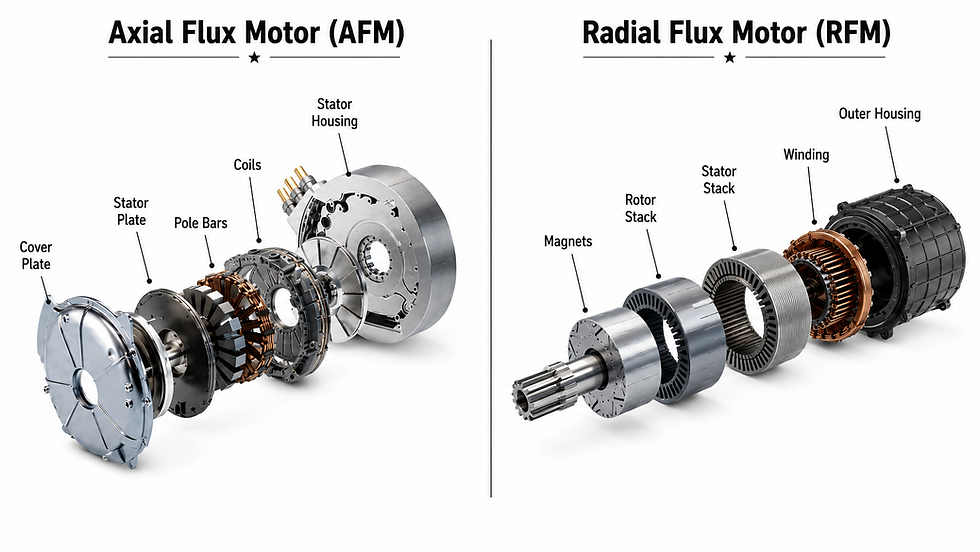
Against this background, REBIO is prototyping a next-generation UGV powertrain concept involving axial flux motors and solid-state batteries. In a conventional radial flux motor, the principal magnetic flux crosses the air gap radially. In an axial flux motor, it crosses primarily along the machine's axis of rotation. Axial flux configurations can offer shorter axial dimensions and, under suitable electromagnetic and mechanical designs, attractive torque density and packaging characteristics. These properties make the technology worth investigating for UGV platforms where drivetrain volume, mass distribution and mechanical integration are tightly constrained.
The potential advantages come with additional engineering demands. Axial flux machines may present more challenging requirements for air-gap control, manufacturing precision, rotor mechanical integrity and thermal design. A motor that achieves high peak torque does not necessarily sustain the same output under continuous heavy loading. Meaningful evaluation must therefore consider continuous power, efficiency maps, temperature rise, gearing requirements and manufacturing repeatability. Ultimately, the relevant comparison is between complete powertrain assemblies—including motors, inverters, reduction gearing and cooling accessories—not merely two standalone electric machines.
Solid-state batteries require the same discipline. Different solid electrolytes and electrode chemistries present distinct trade-offs in energy density, interface resistance, charge and discharge capability, cycle life, safety and manufacturing cost. The term “solid-state” does not automatically guarantee higher usable energy density, nor does it remove the need for protection or thermal management at pack level. In TerraMate's new powertrain development, the meaningful measures will include usable pack energy, gravimetric and volumetric energy density, temperature-dependent power delivery, and the actual effects on vehicle payload and operational endurance.
Lightweight engineering should therefore not be reduced to making individual components smaller. Its real objective is to increase the useful capability delivered by an entire system within defined mass, volume and operating constraints. In electric aviation, that means preserving safe flight performance and payload; in UGVs, it means obtaining dependable propulsion, practical load capacity and mission-appropriate energy storage without introducing disproportionate complexity.
4. Why CE-25A Uses Air Cooling While Desert UGVs May Need Liquid Cooling
Thermal management is one of the clearest examples of the trade-offs between efficiency, mass and reliability in high-power-density electric systems. Even highly efficient motors generate heat through copper losses, magnetic losses and other mechanisms. Power-electronic converters introduce their own conduction and switching losses. If the resulting heat cannot be removed effectively, localized temperature rise may accelerate insulation ageing, affect magnetic material performance, reduce component life or trigger protective shutdowns.
The CE-25A's propulsion system follows a particularly instructive approach. IEE reports that its development team selected a forced-air cooling architecture using airflow within the propulsion ducts. This was combined with close integration of the motor and converter, optimized heat-dissipation structures and electromagnetic compatibility measures. Compared with architectures requiring additional liquid pumps, coolant circuits and associated hardware, this approach can reduce some cooling-system mass and integration complexity. Its significance is not that air cooling is universally superior, but that the designers exploited airflow already available in the propulsion configuration to meet the aircraft's particular requirements.
The thermal environment of a ground vehicle can be substantially different. Unlike an aircraft propulsion duct with a designed forced-air flow, a UGV may spend extended periods operating at low speed, high torque and elevated ambient temperature. Driving through deep sand increases rolling resistance and can produce significant slip-related energy losses. Sustained climbing or towing may increase the thermal load on the powertrain, even as reduced vehicle speed limits naturally available ram-air cooling. On platforms requiring strong protection against dust and water ingress, simply increasing ventilation openings may also compromise enclosure design.
REBIO has accumulated practical experience with air-cooled electric-drive configurations on existing TerraMate platforms. Under appropriate load profiles, power densities and ambient conditions, air cooling remains attractive because of its mechanical simplicity and relatively modest maintenance requirements. The development of liquid cooling does not make established air-cooled systems obsolete. Rather, it creates an opportunity to address more demanding operating conditions, particularly in high-temperature desert environments across the Middle East and North Africa and in future UGV configurations incorporating higher-power-density axial flux motors.
REBIO is therefore developing liquid-cooling technology for UGV operation in extreme heat. The engineering objective is to improve the controlled transfer of heat from electric machines and power electronics to suitable heat-exchange surfaces, providing greater thermal design margin for sustained operation. In axial flux machines, thermal analysis must consider not only externally measurable casing temperature but also internal stator hotspots and the temperatures experienced by rotor and magnetic materials. Cooling performance must be considered together with electromagnetic design, mechanical construction and motor-control strategy.
Liquid cooling is not a free performance upgrade. Heat must ultimately be rejected to the surrounding environment, so a cooling loop remains constrained by ambient temperature, heat-exchanger effectiveness, airflow, contamination and parasitic pump power. High-temperature desert conditions, accumulated dust and prolonged low-speed operation can still limit the system's heat-rejection capacity. A robust design must therefore consider the complete heat path, rather than simply the ability of coolant to circulate around a motor.
Adding a liquid circuit also introduces new failure modes, including pump malfunction, leaks, restricted flow, sensor failure and coolant degradation. Development testing should examine not only steady-state cooling performance but also degraded conditions and safe responses to thermal-management faults. The ability of a controller to detect inadequate cooling, reduce output when necessary and initiate a controlled shutdown can be as important as the cooling system's nominal heat-transfer capability.
The CE-25A's air-cooled propulsion system and a liquid-cooled desert UGV are not competing answers to the same engineering problem. They are solutions optimized for different operating environments. The transferable lesson is not a particular cooling medium, but the discipline of selecting a thermal-management architecture according to actual duty cycles, available airflow, mass budgets, maintenance requirements and failure risks.

5. From a 400-Kilometre Aircraft to Dual UGV Powertrain Strategies: Range Begins With Mission Definition
The CE-25A's reported 400-kilometre design range reflects the intended application of its battery-electric architecture in regional aviation. Electric propulsion can eliminate direct combustion emissions during flight and potentially simplify parts of the propulsion maintenance system. Yet battery mass, usable energy, charging infrastructure, reserve requirements and aircraft turnaround time remain decisive constraints. For a commercial operator, maximum range alone is not the most useful performance measure. What matters is whether the aircraft can repeatedly complete scheduled services while meeting payload, safety and economic requirements.
Range assessment for unmanned ground vehicles follows a similar logic. A vehicle travelling at constant speed on a paved road can have a dramatically different energy requirement from the same vehicle carrying a full payload through loose sand, climbing repeatedly or operating stationary auxiliary equipment for extended periods. Usable battery energy is only one part of the equation. Rolling resistance, gradients, speed, transmission efficiency, auxiliary loads and ambient temperature all affect actual operational endurance. Vehicles carrying sensors, communications equipment or other powered payloads also need to account for continuous electrical demand beyond propulsion.
This is why pure-electric and hybrid powertrains should not automatically be treated as successive technological generations, with one replacing the other. Pure-electric UGVs offer advantages for low-noise movement, precise torque control and operations where engine-off travel is important. They can support extended-distance missions when sufficient battery capacity, route planning and energy reserves are available. Electric drive, however, does not imply complete silence; tyres, gearing, suspension and other mechanical systems still produce noise.
In deserts, mountains and remote operating areas where dependable charging infrastructure is limited, hybrid or range-extended configurations address a different requirement. Onboard fuel provides an additional energy source that can reduce dependence on fixed charging points along a route. Existing TerraMate 4×4 and TerraMate 6×6 product specifications describe range-extended hybrid configurations, with rated payloads of 500 kg and 800 kg and stated ranges of at least 150 km and 110 km, respectively. These figures apply to their specified configurations and are not universal predictions of performance under every terrain, payload or temperature condition.

Both architectures involve compromises. Hybrid systems add an engine, generator, fuel supply and associated maintenance and thermal-management requirements. Pure-electric systems must balance battery mass, charging availability and usable energy reserves. For TerraMate's next-generation development, REBIO is pursuing pure-electric and hybrid powertrain options that can be selected according to mission needs. The planned integration of axial flux motors, solid-state batteries and advanced cooling technologies must serve that overall architecture rather than become an objective in itself. Availability and validated performance will remain dependent on the specific model and its development status.

The range challenge in electric aviation and the endurance problem in UGVs therefore point to a common conclusion: energy architecture must follow the mission, not the other way around. The most useful objective is not the largest possible range figure without qualifications, but the amount of useful work that can be reliably completed within defined environmental, payload, operational and safety boundaries.

6. What Western Electric Aircraft Programmes Reveal About the Real Barriers to Commercialization
While the CE-25A demonstrates progress in China's electric aviation research, the experience of Western aircraft developers provides another important perspective. A successful prototype flight and a commercially sustainable aircraft programme are separated by years of engineering verification, certification, manufacturing development and capital investment. Electric aviation is particularly exposed to these constraints because batteries, propulsion motors, power electronics, airframe structures, control software and safety systems must satisfy demanding requirements simultaneously.
Eviation's Alice programme illustrates the gap between technical demonstration and industrial maturity. The nine-seat battery-electric aircraft completed its first flight in 2022, attracting considerable international attention. In February 2025, however, Eviation paused development and substantially reduced its workforce amid financing and partnership challenges. The successful prototype flight demonstrated a meaningful technical milestone, but it did not establish that certification costs, manufacturing investment, supply-chain readiness and long-term programme funding had all been resolved. It would be inaccurate to attribute the programme's difficulties to a single failed motor or battery technology.
Sweden's Heart Aerospace provides a different example. Its X1 all-electric demonstrator completed its first flight in August 2026, and the company subsequently unveiled the ES-36, a 36-seat hybrid-electric regional aircraft, in September. The transition in product configuration reflects a reassessment of how passenger capacity, range, operating economics and current energy-storage limitations can be balanced. The programme still faces the substantial challenges of certification, production and operational validation, but a shift toward a hybrid architecture should not be confused with abandonment of electric aviation.

Together, these developments reveal a frequently underestimated principle: technological innovation determines what a product may be capable of achieving; industrialization determines whether that capability can be delivered consistently and sustainably. A high-performance motor becomes a commercially dependable component only when its design, materials, manufacturing processes and inspection results can be reproduced reliably. A battery becomes suitable for large-scale deployment only when its safety, lifetime, quality and traceability are controlled. Supply-chain capability is therefore not merely the ability to purchase components from multiple vendors. It is the ability to coordinate design, production, verification and long-term technical support across an entire system.
Exactly the same challenge applies to UGV manufacturing. A sophisticated platform may integrate motors, inverters, batteries, gear reducers, braking systems and control electronics from different suppliers. Even if each component meets its individual specification, the resulting vehicle may still suffer from inconsistent performance when interfaces, software versions, thermal boundaries, electromagnetic compatibility or fault-handling procedures are insufficiently standardized. A successful prototype does not automatically translate into repeatable production quality.
The difficulty becomes more apparent when vehicles are deployed internationally for years rather than demonstrated locally for days. Replacement components must remain available, maintenance information must be accessible, software and hardware revisions must be controlled, and field failures must feed back into engineering decisions. Under these conditions, supply-chain continuity is not simply a commercial advantage. It becomes part of the system's practical reliability.
7. From China's Electric Aviation Supply Chain to Overseas UGV KD Manufacturing: Reproducing Reliability Across Borders
The CE-25A programme brings together COMAC, the Chinese Academy of Sciences' Institute of Electrical Engineering and other organizations specializing in batteries, materials, electronics and aircraft systems. It illustrates how modern electric aviation depends on coordinated industrial capabilities rather than the achievements of a single manufacturer. The value of such a supply chain is not simply that it contains capable component producers, but that their technologies can be integrated into a coherent process of design, manufacturing, testing, quality assurance and continuous improvement.
For the global UGV market, industrialization adds a geographical dimension. Customers increasingly need the ability to integrate, maintain and upgrade equipment locally rather than depend indefinitely on fully assembled imports. This demand may reflect procurement policies, but it is also driven by practical requirements for spare-parts availability, shorter repair cycles, technical training, field customization and domestic industrial capability. For vehicles deployed in deserts, mines or remote infrastructure environments, the time required to restore a failed platform to service can be as important as its nominal performance specifications.
These considerations explain the growing relevance of knocked-down (KD) assembly and localized manufacturing models. A technically meaningful KD programme is not merely the shipment of dismantled vehicles for reassembly. It requires the transfer of product definitions, standardized components, tooling, assembly procedures and quality-control methods that can be repeated in another production environment. A complete implementation must define component specifications, electrical and mechanical interfaces, software configurations, inspection equipment, personnel training, final acceptance criteria and spare-parts procedures.
REBIO is applying its experience in cross-border industrialization to the development of overseas TerraMate UGV KD cooperation models. The objective is to connect established Chinese component and vehicle manufacturing capabilities with local assembly, systems integration, verification and lifecycle-support resources. Rather than requiring a partner to recreate an entire upstream industrial ecosystem, such an approach can provide a structured path toward local operational capability while preserving defined product and quality standards.

Future UGV powertrains incorporating axial flux motors, solid-state batteries and advanced liquid cooling will place additional demands on this manufacturing model. These technologies must progress beyond laboratory and prototype performance to clearly defined assembly tolerances, electrical safety procedures, cooling-system inspection methods, component traceability and maintenance documentation. Until the relevant designs complete the necessary validation and production-readiness work, their potential technical advantages should not be treated as a promise of immediate serial production.
The value of this approach also extends to application integration. A UGV carrying mobile CBRN detection equipment, for example, must sustain not only mobility but also reliable sensor power, suitable environmental conditions for instruments and continuity of mission data. A vehicle used for long-duration infrastructure inspection may place greater emphasis on service access, replacement parts and predictable maintenance intervals. These operational requirements turn the vehicle platform into one element of a broader engineering and support system.
Seen in this context, Chinese electric aviation and overseas UGV industrialization are connected by a common challenge: moving from capable components to dependable integrated systems, and from dependable systems to repeatable, sustainable manufacturing. The most valuable industrial expertise is not confined to drawings, patents or individual prototypes. It resides in the processes that allow engineering performance to be verified, reproduced, supported and improved across different locations.

Conclusion: The Next Phase of Electrification Will Be Defined by Reliability
The significance of the CE-25A extends beyond another successful test flight. It demonstrates that electric propulsion is moving into applications with demanding safety requirements, greater system complexity and more challenging commercial constraints. Distributed propulsion, high-power-density motors, lightweight structures and advanced thermal management expand the possibilities of electric aircraft design. Whether those possibilities mature into sustainable commercial operations will depend on continued safety verification, systems integration, manufacturing consistency and long-term operational performance.
A similar transition is taking place in unmanned ground vehicles. TerraMate's existing platforms are built around established drivetrain and chassis architectures supported by extended road-testing requirements. The axial flux motor, solid-state battery powertrain and high-temperature liquid-cooling technologies under development represent possible directions for further optimization. They may improve packaging efficiency, powertrain mass distribution and thermal-management capability, but any such benefits must be demonstrated through testing and evaluated against reliability requirements throughout the product lifecycle.
From aviation to ground robotics, the real value of electrification lies not in how many emerging technologies are incorporated into a product, but in whether those technologies work together reliably under defined energy, environmental and safety constraints. A technological breakthrough may be demonstrated in a single test. Reliability must be established through sustained operation and repeatable manufacturing.
The next generation of high-performance electric platforms will not be defined simply by who adopts new technology first, but by who can consistently turn that technology into dependable operational capability.

References and Further Reading
Xinhua — China's 10-tonne-class electric commercial aircraft completes its first piloted flight: https://www3.xinhuanet.com/politics/20261114/cb8c94c4e6cc4a809ec8d81b7167b36b/c.html
Institute of Electrical Engineering, Chinese Academy of Sciences — 2 MW distributed electric propulsion system validated in flight: https://iee.cas.cn/xwzx/kydt/kxdt2020_241134/202611/t20261118_8311373.html
Civil Aviation Administration of China — CCAR-25 airworthiness regulatory information: https://www.caac.gov.cn/XXGK/XXGK/ZFGW/202404/t20240409_223444.html
GeekWire — Eviation pauses Alice development and reduces its workforce: https://www.geekwire.com/2025/eviation-lays-off-employees-and-pauses-development-of-electric-powered-airplane/
Heart Aerospace — X1 electric demonstrator completes first flight: https://www.heartaerospace.com/newsroom/heart-aerospace-completes-first-flight-of-world-s-largest-electric-aircraft
Heart Aerospace — ES-36 hybrid-electric regional aircraft unveiled: https://www.heartaerospace.com/newsroom/heart-aerospace-unveils-es-36-with-jsx-purchase-agreement-for-up-to-100-aircraft
Related Engineering and Industrialization Insights from REBIO GROUP
TerraMate Unmanned Ground Vehicle Platforms: https://www.rebiogroup.com/military-grade-solutions/unmanned-ground-vehicle
Next-Generation UGV Powertrain Development: https://www.rebiogroup.com/insights/zxmoto-worldssp-next-generation-tactical-ugv
UGV Local Assembly and Lifecycle Support: https://www.rebiogroup.com/insights/ugv-local-assembly-lifecycle-support

Comments