From ZXMOTO’s WorldSSP Breakthrough to the Next Race in High-Performance Mobility: Where is the Next-Generation Tactical UGV Power Platform Heading?

Updated: Jul 21
When Valentin Debise pulled off a stunning, critical overtake on the final lap at the Misano circuit to secure ZXMOTO’s sixth race win of its maiden season, it was already much more than a sports headline generating regional buzz. As western authoritative motorcycle media noted, the "WorldSSP-winning ZXMoto" is reshaping the global market's perception of Chinese electromechanical brands. This historic track breakthrough sends an incredibly strong industrial signal: Chinese manufacturing is moving beyond the old narrative of low-cost supply chains and comprehensively advancing into the high-performance engineering sector, centered on electric drives, thermal management, and system integration. This same underlying logic of technological evolution is reshaping the performance boundaries of another highly strategic sector: unmanned ground vehicles (UGV). The next-generation tactical UGV power platforms, represented by REBIO GROUP’s TerraMate, are redefining the power standards and mission boundaries of UGV platforms by integrating axial flux motors, VCU 2.0, liquid cooling systems, and a forward-looking solid-state battery roadmap.
ZXMOTO's Victory: Why It's More Than Just Motorcycle News
The WorldSSP (World Supersport Championship) has historically been the ultimate proving ground for the world's top two-wheel manufacturers to showcase their high-performance technology reserves. According to official reports from WorldSBK, ZXMOTO strongly secured six race victories in its very first season entering the competition. This is not merely a triumph of team operations or individual rider skill, but a comprehensive victory of the underlying engineering R&D, material science, aerodynamics, and top-tier supply chain integration capabilities.
In the globalized division of labor over the past few decades, the international market's stereotype of Chinese manufacturing has often remained stuck on "massive production scale," "extremely fast delivery speeds," and "absolute cost advantages." However, extreme competition on high-level racing tracks cannot be sustained simply by a low-price logic. The sustained high-power output of engines under extreme conditions, the balance of high strength and lightweight frame design, and the rapid iteration capability based on massive data collectively build true competitive barriers. Therefore, ZXMOTO's successful breakthrough clearly indicates that Chinese high-end equipment enterprises have acquired international race-level technological endorsements and have officially entered a stage of more complex, demanding systems engineering competition.
Chinese Manufacturing is Shifting from "Supply Chain Advantage" to "Systems Engineering Advantage"
In this fierce competition of systems engineering, the revolution of underlying electric drive technology is particularly striking. Public industry research reports and media analyses point out that the axial flux motor is becoming the key technological path to breaking through the performance bottlenecks of existing electric drive platforms.
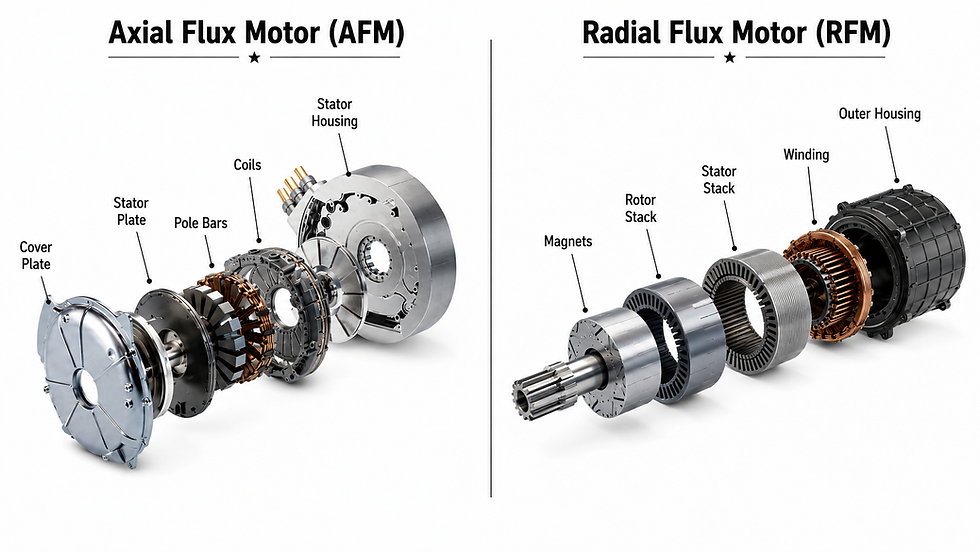
Compared to widely used traditional radial flux motors, axial flux motors demonstrate disruptive advantages in their physical architecture: they can unleash exponentially higher power density with a shorter axial length and lower overall system weight. According to data disclosed by authoritative automotive and technology media, Chinese research teams have made breakthrough progress in the field of high-performance axial flux motors, with their developed equipment achieving an astonishing power density of 25.73 kW/kg at an ultra-high speed of 18,000 rpm.
Currently, there are indications that Chinese high-performance mobility platform enterprises are actively exploring or paying attention to this cutting-edge technology. This ultimate compactness and lightweight characteristic not only meets the needs of passenger cars and high-performance racing cars but also provides a highly promising power solution for commercial vehicles, robots, low-altitude aircraft (eVTOL), and tactical UGV platforms that are extremely sensitive to spatial layout and weight.
Why Will the "Axial Flux Motor" Become the Keyword for Next-Generation High-Performance Mobility Platforms?
In this fierce competition of systems engineering, the revolution of underlying electric drive technology is particularly striking. Public industry research reports and media analyses point out that the axial flux motor (AFM) is becoming the ke
technological path to breaking through the performance bottlenecks of existing electric drive platforms.
Compared to widely used traditional radial flux motors, axial flux motors demonstrate disruptive advantages in their physical architecture: they can unleash exponentially higher power density with a shorter axial length and lower overall system weight. According to data disclosed by authoritative automotive and technology media, Chinese research teams have made breakthrough progress in the field of high-performance axial flux motors, with their developed equipment achieving an astonishing power density of 25.73 kW/kg at an ultra-high speed of 18,000 rpm.
Currently, there are indications that Chinese high-performance mobility platform enterprises are actively exploring or paying attention to this cutting-edge technology. This ultimate compactness and lightweight characteristic not only meets the needs of passenger cars and high-performance racing cars but also provides a highly promising power solution for commercial vehicles, robots, low-altitude aircraft (eVTOL), and tactical UGV platforms that are extremely sensitive to spatial layout and weight.
From the Track to Tactical Ground Platforms: UGV's More Complex Demands on Powertrains
Although on the same technology curve of high-performance manufacturing, the switch in application scenarios brings completely different engineering challenges. If track motorcycles pursue ultimate instantaneous speed, sharp handling, and straight-line acceleration, the tactical UGV's demands on the power system exhibit a more stringent, multi-dimensional complexity.
For a UGV executing frontline logistics support, detection, or patrol missions, every kilogram of chassis weight, every watt of continuous output power, and every degree Celsius of core temperature rise can directly determine whether the platform can break through environmental limitations. A UGV platform must not only cope with the high-intensity physical impact of unpaved surfaces but also possess massive torque output at extremely low speeds to achieve heavy-load climbing. At the same time, its compact chassis space must safely and simultaneously accommodate high-density battery packs, multi-modal communication modules, payload interfaces, and necessary physical protection structures. This forces the UGV to completely depart from traditional vehicle architectures, evolving into a highly integrated mobile energy and mission hub.
TerraMate Next-Generation Power Platform: Not Just a Motor Upgrade
Based on a deep understanding of cutting-edge technology trends and high-intensity mission requirements, REBIO GROUP is steadily advancing the prototyping and validation of a new-generation electric mobility platform architecture for its TerraMate UGV. The evolution of the TerraMate platform is by no means a simple component replacement, but the construction of a brand-new powertrain chassis ecosystem capable of adapting to future tactical mission needs.
Exploring Axial Flux Motor Architecture
REBIO's next-generation power platform is being architected around axial flux motor technology. The application of this technology is expected to significantly compact the chassis of the TerraMate UGV, freeing up highly valuable top and internal payload space for customers while maintaining or even enhancing power density.
VCU 2.0 Vehicle Control Unit
Powertrain control is experiencing a leap from single drive commands to "mission-level energy management." The VCU 2.0 system introduced by TerraMate can execute high-precision torque distribution and energy scheduling based on terrain feedback and current mission loads, ensuring the UGV's system stability and adaptive capabilities in complex tactical environments.
Advanced Liquid Cooling System
Addressing the harsh conditions UGVs frequently face, such as high-temperature environments, ultra-high loads, and long periods of uninterrupted operation, advanced liquid cooling systems have become standard. This system can effectively suppress thermal degradation, ensuring that core electric drive components maintain stable physical characteristics even under extreme working conditions, making high-load output a sustainable norm.
Forward-Looking Solid-State Battery Roadmap
In terms of energy storage, TerraMate is not limited to existing lithium battery technology but has reserved a roadmap for a smooth upgrade to solid-state battery technology from the underlying physical architecture. This forward-looking design aims to provide future UGV platforms with breakthrough physical safety and leapfrog mission range.
The Future of UGV Competition: Platform Architecture, Not Spec Sheets
In the current defense and special equipment market, single paper parameters—such as top speed or nominal range—are easily replicated and surpassed by competitors through reverse engineering. However, what can truly build long-term industry barriers is the system-level architectural framework hidden deep within the chassis.
The core of future tactical UGV competition has completely evolved into deep hardware synergy and software decoupling among motors, high-voltage batteries, VCU strategies, liquid cooling pipeline layouts, and modular mission interfaces. The core commercial value of REBIO TerraMate lies exactly here: it is not just delivering an isolated UGV terminal, but providing a highly integrable, flexible, and sustainably upgradable fundamental unmanned mobility architecture for industrial and defense clients globally.

Conclusion: From ZXMOTO to TerraMate, Chinese High-Performance Manufacturing Enters a New Stage

When a Chinese motorcycle brand continuously secures victories on the world's top rigorous tracks, it is not just a racing highlight, but a declaration of strength to the global industrial sector: Chinese manufacturing has completely broken through the technological ceiling and possesses the hard-core engineering capabilities to dominate high-performance, high-complexity application scenarios.
The validation and development of REBIO GROUP's TerraMate next-generation UGV power platform is a natural extension of this deep system-level engineering capability into the realm of tactical unmanned ground vehicles. In this highly uncertain market, the focus of future competition is no longer "who can piece together a UGV," but "who can continuously deliver and iterate a UGV mobility base platform with high reliability, extreme power density, and support for modular mission deployment." This invisible race, centered on underlying electric drive architecture and system integration, has just begun.


Comments