Disaster Logistics UGV Under Fire: What China’s First CNAS-Standard UGV Inspection Certificate Really Proves

A disaster logistics Unmanned Ground Vehicle (UGV) seldom provides the most dramatic image of a catastrophe. It does something more useful: it keeps food, water, pumps, power and medical supplies moving after the road has ceased to behave like a road. As wildfires in France and Spain coincide with fire, flood and smoke across the United States, the strategic question is no longer whether emergency agencies possess enough specialised equipment in aggregate. It is whether that equipment can reach the final dangerous kilometre when several disasters are competing for the same crews, trucks and aircraft.
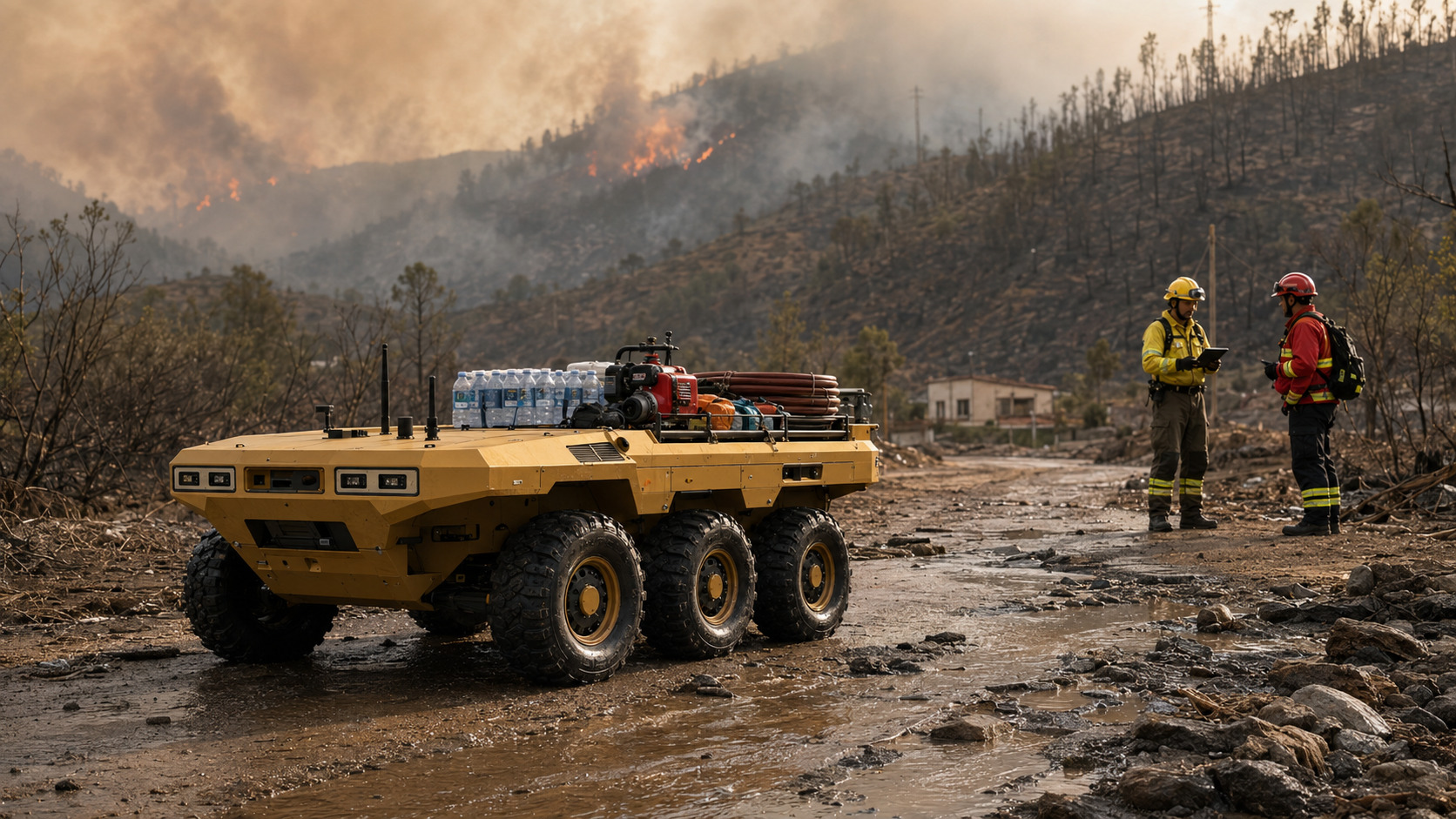
When Disasters Converge, Transport Capacity Often Runs Out Before Courage Does
Europe’s summer has made the arithmetic unpleasantly clear. Reuters reported that a fast-moving wildfire near Fréjus on France’s Mediterranean coast had burned roughly 180 hectares by the evening of July 19, forcing evacuations and interrupting rail services between Toulon and Les Arcs. A separate blaze near Paris earlier in the month prompted the evacuation of as many as 800 people and the first deployment of water-bombing aircraft in the Greater Paris region. France had already lost around 32,000 hectares to fire in 2026, more than in all of the previous year.
Spain’s experience has been grimmer. A fire in Almería province burned about 7,000 hectares and killed 13 people, making it one of the country’s deadliest wildfires in decades. Elsewhere in north-eastern Spain, another blaze scorched more than 12,000 hectares and forced over 1,000 people to leave their homes. Each incident is serious by itself. Occurring in close succession, they begin to behave like a campaign: crews rotate more slowly, maintenance backlogs grow, fuel and water must travel farther, and aircraft hours become scarce.
Across the Atlantic, the same problem has appeared in a more complicated form. Reuters counted 68 large fires active across 15 American states, with more than 17,400 personnel supported by helicopters and military aircraft. At the same time, parts of Texas received more than 27 inches of rain, while smoke from Canadian fires placed over 100m people under air-quality alerts. Fire, flood and smoke do not merely add their damage together. They compete for the same command attention, transport capacity, communications bandwidth and technical staff.
This is where the language of “response assets” becomes misleading. A helicopter can drop water, a boat can cross a flooded street and a truck can carry a large load. Yet none is automatically available, economical or safe for every leg of the mission. The limiting factor is often the handover between them: the point at which a pallet leaves a depot, reaches the edge of the damaged road network and must still travel through heat, mud, debris or contaminated air.

A Disaster Logistics UGV Is Not a Fire Engine. It Is a Supply Line.
The case for a disaster logistics UGV is therefore less glamorous than the case for a robot that appears to “fight” a disaster. Its value lies in repeatability. It can shuttle drinking water and batteries, tow a pump, move hose, carry communications equipment, deliver meals, recover tools and return for another load without requiring a driver to remain inside the hazard envelope.
That distinction matters. Emergency agencies do not need every unmanned vehicle to imitate a fire engine or an ambulance. They need machines that preserve the scarce human capacities around those vehicles. If a remotely operated platform carries equipment into a smoke-filled corridor, the firefighter who would have driven or walked that route can remain at a safer stand-off point. If it transports supplies over unstable ground, the rescue team can reserve its time and attention for tasks requiring judgment, dexterity and human contact.
The safety gain is not absolute. An unmanned machine can still roll over, lose communications or block a narrow route. Batteries and sensors do not abolish operational risk. But they change who absorbs it. The most hazardous metres can be assigned first to expendable hardware; people enter later, with better information and fewer loads to carry. The U.S. National Institute of Standards and Technology treats this as a measurable engineering problem. Its response-robot programme has developed more than 50 test methods and standardised more than 20, covering mobility, endurance, communications, autonomy, logistics and safety. For a buyer, this is a useful corrective to spectacular demonstration footage: capability is valuable only when it is repeatable.
Two-Stage Logistics: Wheels Move Fast; Tracks Move Close
No single chassis geometry wins every disaster. Wheeled machines generally travel faster and farther on mixed roads and trails; tracked machines generally trade speed and efficiency for traction, low-speed control and close work over rubble, ash and soft ground. Treating them as rivals misses the operational point. The more useful model is two-stage logistics.
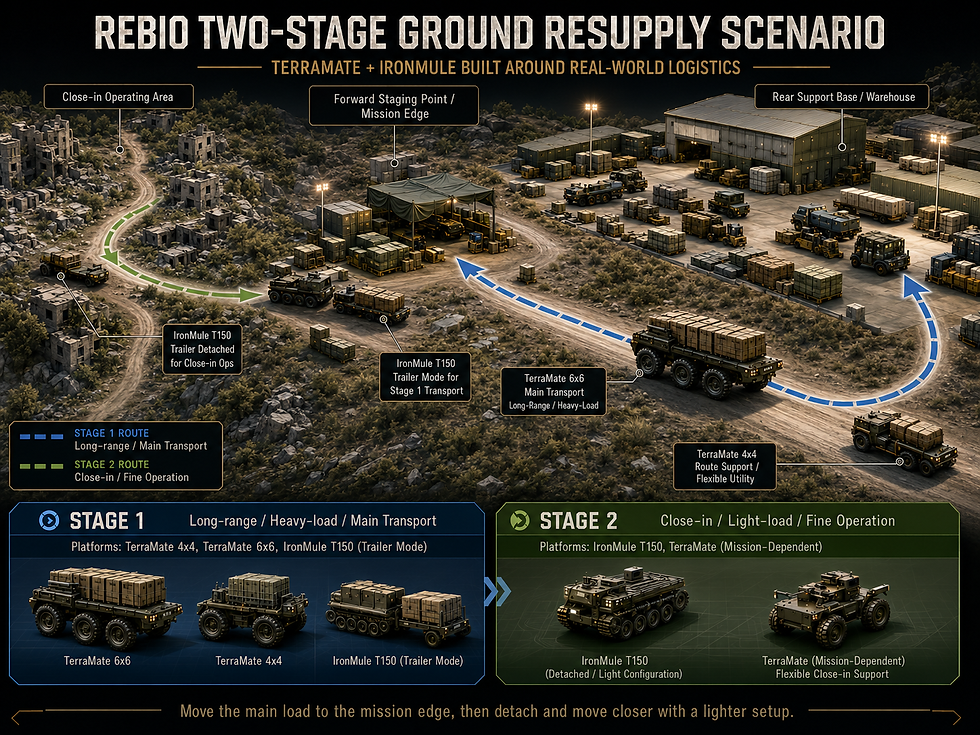
Wheeled Platforms: Pushing the Mission Edge Forward
A wheeled platform carries bulk supplies from a rear depot towards the edge of the damaged network.
It covers the relatively long, mixed-surface leg quickly and can repeat the trip with less energy consumption than a tracked vehicle of similar size.
Its job is to move the “mission edge” forward: the point from which people and smaller machines can operate without returning to the main road after every task.
REBIO GROUP’s TerraMate 4x4 and 6x6 fit this part of the chain. Their role is not to chase flames. It is to bring payload, electrical power and mission modules to a forward transfer point over broken roads, gravel, slopes and shallow water. The larger six-wheeled platform has a rated payload of 800kg, giving it enough capacity for pumps, generators, water, food, tools or a modular field-support body. In disaster logistics, payload is not a brochure ornament; it determines how many journeys, exposed handovers and human lifting tasks can be removed from the day.
Tracked Platforms: Handling Close-In Field Work
A compact tracked platform takes smaller or specialised loads beyond the transfer point.
It works near heat, smoke, debris, soft shoulders and confined approaches where speed matters less than traction and controllability.
It can tow a pump or water module, carry hose and tools, or make repeated short runs while operators remain at a safer distance.
This is the natural mission for the IronMule T150. The tracked machine is intended for close-in field work rather than the long approach. In practice, it could receive equipment from a TerraMate vehicle and carry it through the last, roughest section of the route. A field video of the IronMule T150 is revealing precisely because it shows the uncelebrated virtues that matter there: controlled low-speed movement, obstacle negotiation and a compact platform that can accept different working loads.
Such a division of labour also makes fleet planning more rational. Sending a tracked machine over every kilometre wastes time and energy. Sending a fast wheeled machine into every heap of unstable debris risks immobilising a more valuable long-range asset. Two-stage logistics allows each platform to operate where its geometry has an advantage. It also gives commanders a modular system rather than a single, expensive answer to every hazard.
Guangxi Left More Than Rescue Footage Behind
The floods in Guangxi, China, offered a useful earlier test of this logic. Associated Press reporting cited 39 deaths, nine people missing and roughly 130,000 residents evacuated; more than 10,000 students and teachers were also transferred from flooded areas. In some cut-off locations, an aerial delivery that took three or four minutes replaced a two- or three-hour boat journey. One civilian team reportedly made 35 flights in four hours and delivered around four tonnes of supplies.
Those figures demonstrate the strengths of an aerial bridge, but also its limits. Medicine and urgent packages can fly over a broken road; sustained flows of food, pumps, generators and shelter equipment still favour the ground once a passable route—however poor—can be found. The earlier REBIO analysis of the Guangxi floods described a TerraMate 6x6-based all-terrain unmanned meal-reheating and heat-preservation vehicle used in related support operations. On-site photographs and detailed mission records were restricted. That makes independent test evidence more important, not less.
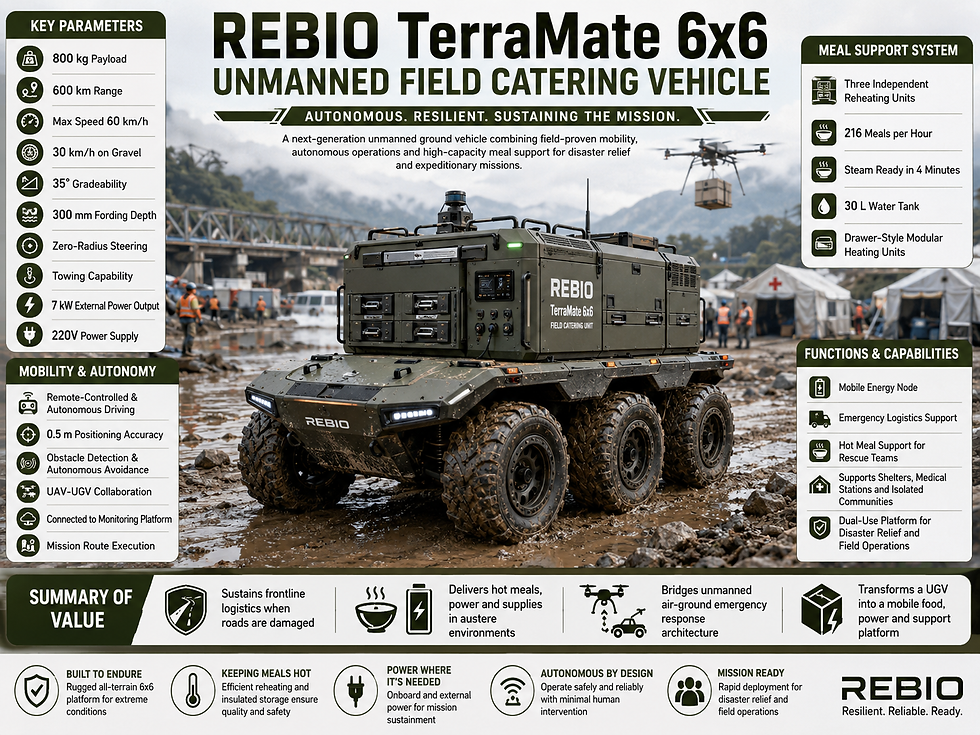
How to Read “China’s First Third-Party CNAS-Standard Inspection Certificate”
The vehicle had received what REBIO describes as China’s first third-party CNAS-standard inspection certificate for an all-terrain unmanned meal-reheating and heat-preservation vehicle. The cover of the inspection report bears CMA, CNAS Testing and ILAC-MRA marks. The phrase deserves careful reading, because three claims are often bundled together when they should be separated.
“Third-party” means the reported tests were performed by an organisation independent of the manufacturer and customer, rather than by the vendor alone.
The CNAS mark refers to the accreditation status and scope of the laboratory or inspection body. CNAS rules state that accredited bodies may use the mark on reports or certificates issued within their recognised scope.
The ILAC-MRA/CNAS combined mark indicates that China’s accreditation system participates in the relevant international mutual-recognition arrangement. It supports confidence in the competence behind the test result; it does not turn one report into universal product approval for every country or mission.
That last distinction is important. CNAS explicitly warns that use of its mark must not imply that CNAS itself is responsible for a report’s result or interpretation. Nor does a laboratory report replace local conformity assessment, procurement trials or operational acceptance. A European civil-protection agency, for example, may still require its own radio, battery, machinery, road-use and safety checks. The certificate is best understood as a disciplined starting point: a traceable record of what was tested, by whom, under what conditions and with what result.
For buyers comparing platforms across borders, that is already a substantial improvement over a manufacturer’s data sheet. A claim such as “climbs steep slopes” is elastic. A report with a named configuration, method, measured value and compliant result can be audited and repeated. It narrows the space in which marketing language can hide.
What Was Actually Quantified Was a Set of Mission Capabilities
The inspected TerraMate-based system combined ground mobility, payload, external electrical supply, food support and unmanned operation in one configuration. According to the corresponding project material and inspection results summarised by REBIO, the tested claims included:
an 800kg payload;
a task-specific range of up to 600km;
maximum speeds of 60km/h in unmanned mode and 30km/h in manned-control mode;
climbing a 35-degree slope and crossing a 300mm obstacle;
7kW, 220V external electrical output;
reheating and heat preservation for 216 individual meals per hour; and
remote control, autonomous functions and coordinated operation with an aerial platform.
The unusual combination is the point. A disaster vehicle does not create resilience merely by traversing mud. It must arrive carrying something useful, provide power or other services, communicate with the command system and repeat the mission. The 216-meal figure, for example, sounds mundane beside a top-speed number. In a prolonged evacuation, however, hot-food throughput may be more consequential than another increment of velocity.
The 600km figure needs similar discipline. It belongs to a particular task-specific configuration and test context, not to every TerraMate 6x6 under every load, terrain, temperature and power demand. Buyers should ask how the endurance result was obtained, whether it involved a range extender, what payload and auxiliary loads were active, and what reserve policy was used. Good certification encourages such questions. It does not make them unnecessary.

A Certificate Is Only the Starting Point; the Deployment System Is the Answer
Emergency organisations should resist two opposite errors. The first is to dismiss laboratory evidence because real disasters are messy. The second is to assume that a compliant report guarantees field success. The useful position lies between them.
A credible procurement and deployment programme needs several layers of evidence:
laboratory or accredited third-party testing for baseline mobility, payload, power, endurance, communications and safety;
mission-oriented trials using the buyer’s loads, operators, radio network and terrain;
repeated exercises in smoke, rain, darkness and degraded communications;
documented maintenance, battery, spare-parts and recovery procedures; and
after-action data from real deployments, including failures and human interventions.
This is also where software and autonomy should be judged soberly. A machine need not be fully autonomous to reduce exposure. Reliable remote control from a safe stand-off point may remove most of the human risk in a short hazardous corridor. Route following and waypoint navigation can reduce operator workload on repeated supply runs. More advanced autonomy becomes valuable only when it remains predictable around responders, hoses, vehicles and civilians.
Coordination with an aerial platform can improve this system. An UAV can map a blocked road, identify a hot spot or relay communications; a ground platform can then move the heavy payload along the selected route. Yet the air-ground link should be designed around mission continuity, not technological theatre. If the aerial feed fails, the ground vehicle must fail safely. If positioning is degraded, an operator needs a practical fallback. Disaster logistics rewards graceful degradation.
The Last Dangerous Kilometre Needs Reliability, Not Theatre
The simultaneous fires, floods and smoke of this summer are a warning about scarcity. Governments may own many vehicles and aircraft, yet still lack enough deployable capacity at the precise hour and place it is needed. Multi-hazard emergencies expose the distance between inventory and availability.
A two-stage disaster logistics UGV system offers one way to shorten that distance. TerraMate 4x4 and 6x6 vehicles can move heavier loads quickly towards the mission edge. IronMule T150 can take over for close-in work, towing and carrying through the section where heat, smoke, unstable surfaces or debris make human presence most costly. The arrangement is less a procession of robots than a rearrangement of risk.
For REBIO, the immediate commercial opportunity may lie especially with IronMule T150. Fire services, civil-protection agencies, defence groups and industrial-response teams can understand a compact tracked carrier without being asked to redesign their entire fleet. It can begin with a narrow job—moving hose, towing a pump, carrying water or tools—and earn a broader role through exercises. TerraMate then extends the same logic over distance and payload, creating a layered ground network.
The hardest part of disaster response is often the last dangerous kilometre. It is also the part most likely to be treated as an afterthought, because it lies between the large assets that attract budgets and the human courage that attracts headlines. A disaster logistics UGV belongs in that gap. Its success should be measured not by how futuristic it looks, but by how many dangerous journeys no person has to make—and how reliably the next load arrives.


Comments