TerraMate In Flood Response: Why UGV for Disaster Response Is Becoming a Pillar of National Resilience?

Updated: Jul 21
The floods in China Guangxi have pushed a question once confined largely to emergency-management conferences and defense-technology discussions into public view: When roads are washed away, communications infrastructure collapses and entire communities become isolated, who completes the final miles of rescue and sustainment? Heavy-lift drones can cross floodwaters. Long-endurance Wing Loong unmanned aircraft can restore emergency communications from the sky. But maintaining the flow of food, power, equipment and medical supplies over damaged ground requires something more: an integrated air-ground emergency architecture with UGV for disaster response serving as its terrestrial backbone.
Guangxi Floods Are Changing How We Understand Unmanned Rescue Equipment
The most dramatic images from a major flood are usually familiar: roads disappearing beneath muddy water, homes submerged to their rooftops and residents waiting to be evacuated. But another category of images from the Guangxi rescue operation deserves equal attention. Unmanned aircraft are no longer merely observing disasters from above. They are becoming operational infrastructure—directly supporting evacuation, logistics, communications and search-and-rescue missions.
Associated Press reported that prolonged rainfall in Guangxi had killed 39 people, left 9 missing and forced the evacuation of approximately 130,000 residents. Rescue teams also transferred more than 10,000 students and teachers from flooded areas. Statistics may continue to change as rescue work progresses, but the scale of the disaster is already sufficient to demonstrate that conventional vehicles, boats and human rescue teams were facing a system-wide stress test.
Heavy-Lift Drones: From Carrying Supplies to Carrying People
In some of the worst-affected areas, including Hengzhou district, floodwaters severed road access and turned villages into temporary islands. A boat could take two or three hours to complete a round trip. A cargo drone could cover the same route in three or four minutes while carrying approximately 100 kilograms of supplies. Xinhua reported that one civilian rescue team completed 35 flights in four hours, delivering approximately four tonnes of food, drinking water and medicine to three isolated villages. More than 300 volunteer drone pilots reportedly assembled in the affected area.
Some heavy-lift drones moved beyond supply delivery. Two aircraft with wingspans exceeding three metres and payload capacities of approximately 100 kilograms were used to lift two trapped people from rooftops. In other cases, stranded drivers and residents requiring urgent medical care were evacuated through combined drone-and-boat operations.
This does not mean that industrial drones should routinely be used for passenger transport. Human lifting remains an emergency measure, requiring careful risk assessment and authorization by on-site commanders. But it establishes an important fact: when conventional transportation fails, unmanned systems can move directly into the rescue chain rather than remaining limited to surveillance and image collection.
Wing Loong Aircraft Became Temporary Mobile Base Stations
Delivering supplies does not, by itself, establish a functioning rescue chain. When roads are cut, communications are often the next critical system to fail.
In the early morning of July 7, two Wing Loong unmanned aircraft were reportedly dispatched by emergency authorities from Hubei. After approximately three hours of flight, they arrived above heavily affected areas in Guangxi. Operating as airborne communications platforms, they circled above the disaster zone and restored mobile connectivity, reportedly supporting more than 8,000 communications sessions.
The operation demonstrated that modern emergency communications no longer need to depend entirely on fixed terrestrial base stations. Satellites, long-endurance unmanned aircraft, temporary mesh networks and mobile ground nodes can be rapidly combined to rebuild an emergency communications network over damaged infrastructure.
But that development raises a further question. Once airborne platforms have restored the flow of information, and heavy-lift drones have created an emergency aerial corridor, who carries the heavier loads over a longer period and at a lower operating cost?
The answer increasingly points toward UGV for disaster response.
Drones Cross the Gap; UGVs Sustain the Supply Line
Unmanned aircraft and unmanned ground vehicles are not competing technologies.
Drones offer speed, reach and the ability to cross terrain that has become physically inaccessible. They can fly over floodwaters, collapsed slopes and destroyed bridges to conduct reconnaissance, relay communications, deliver medicine and, in exceptional circumstances, evacuate people. But aerial platforms remain constrained by payload, endurance, weather, energy consumption and airspace management.
Ground vehicles bring different strengths: greater carrying capacity, longer operating duration and broader mission adaptability. After floodwaters begin to recede, roads often remain covered by mud, gravel, fallen trees, abandoned vehicles and structural debris. At that stage, rescue operations shift from immediate life-saving intervention toward sustained support.
Food and drinking water must be transported in volume. Pumps, generators, communications terminals and medical supplies must reach forward locations. Temporary shelters need reliable access to hot meals and electricity. Rescue teams must remain supplied for days or even weeks.
This is the practical mission space of UGV for disaster response.
Drones create a rapid but capacity-limited aerial lifeline. Heavy-duty UGVs create a repeatable terrestrial supply route. When both are connected through common communications, positioning and mission-management systems, an integrated air-ground emergency architecture begins to emerge.

What a TerraMate 6x6 UGV That Cannot Be Photographed Tells Us
A military all-terrain unmanned meal-reheating and heat-preservation vehicle built on the REBIO TerraMate 6x6 UGV platform also participated in support operations related to the Guangxi flood response. Because of project confidentiality requirements and on-site operational restrictions, photographs of the vehicle in the disaster area, its precise deployment location and detailed mission records cannot be publicly released. The absence of public photographs, however, does not mean that the vehicle’s capabilities cannot be independently verified.
China’s First Third-Party CNAS-Standard Inspection Certificate
The vehicle obtained China’s first third-party CNAS-standard inspection certificate for an all-terrain unmanned meal-reheating and heat-preservation vehicle, which was issued last March. The inspection report cover carries CMA, ILAC-MRA and CNAS Testing marks. The submitted vehicle was identified as a TerraMate 6x6-based UGV platform. If you are interested, you can contact REBIO staff for this report.
Test results confirmed that the vehicle’s measured performance was fully consistent with the parameters stated in the corresponding TerraMate 6x6 project brochure, with every inspected item receiving a compliant result.

The significance of the report extends well beyond confirming that an unmanned vehicle can move. It places chassis mobility, heavy-load logistics, external electrical supply, unmanned driving, UAV coordination and food-support capability within a single independently tested system.
An 800-Kilogram Payload, 600-Kilometer Range and Seven Kilowatts of Mobile Power
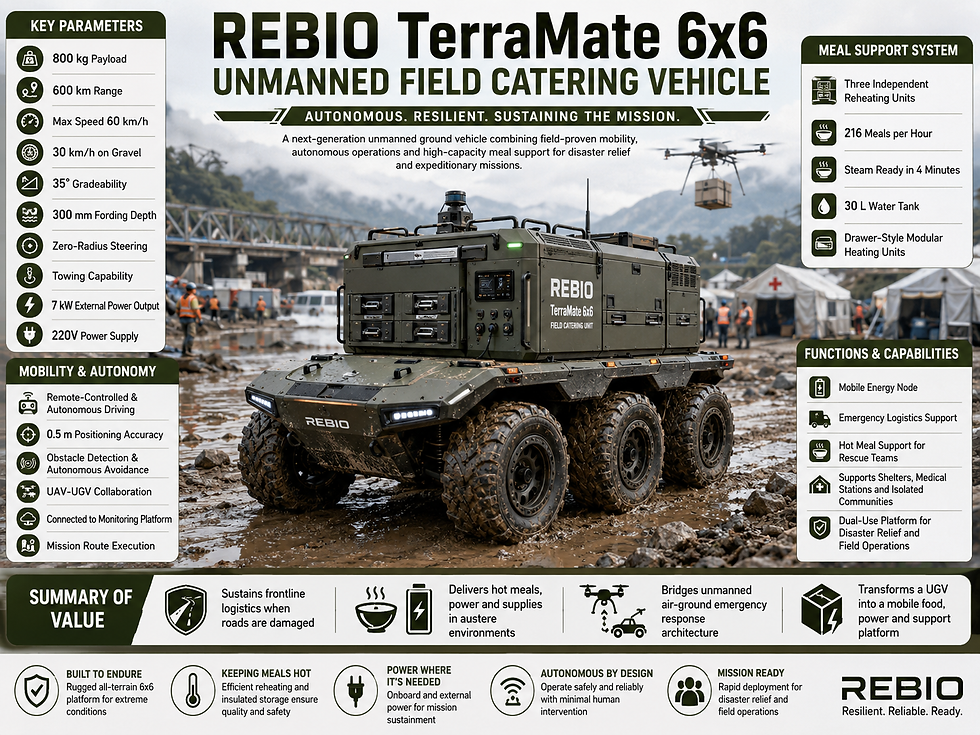
The report records a six-wheel-drive configuration with an effective payload of 800 kilograms and a range of 600 kilometers. The vehicle reached a maximum speed of 60 kilometers per hour on paved roads and 30 kilometers per hour on gravel surfaces. It demonstrated a climbing capability of 35 degrees, a water-fording depth of 300 millimeters, on-the-spot turning and towing capability.
In a disaster environment, these figures are not abstract specifications. An 800-kilogram payload allows the vehicle to transport substantial quantities of food, drinking water, medicine and rescue equipment in a single journey. A range of 600 kilometers reduces dependence on charging infrastructure that may already have been damaged or disconnected. A speed of 30 kilometers per hour on gravel enables the vehicle to maintain useful transport efficiency on unpaved roads and partially damaged routes. Two different towing interfaces at the rear of the vehicle allow it to pull supply trailers, pumps, generators or other emergency payloads. The platform also provides seven kilowatts of external electrical output at 220 volts. In an area without grid power, the vehicle can function as a mobile energy node for lighting, communications terminals, food-processing equipment, electrical tools and other field systems. This is one of the most frequently underestimated aspects of UGV for disaster response. It is not simply a machine that moves cargo from Point A to Point B. It can become a mobile energy, communications and mission-payload platform.
216 Hot Meals per Hour: Logistics Capacity Can Be Quantified
The most widely shared images of a disaster usually capture the moment someone is rescued. But what determines whether an emergency operation can continue for days or weeks is often the logistics activity taking place outside the camera frame.
The TerraMate 6x6-based vehicle is equipped with three independently controlled meal-reheating units. Each reheating cycle takes 15 minutes, giving the system a total capacity of 216 meals per hour. Its onboard steam generator produces steam within four minutes and is connected to a 30-liter water tank.
The reheating modules are installed on drawer-style sliding rails, allowing them to be rapidly removed, replaced or reconfigured.
Two hundred and sixteen hot meals may not create the same visual impact as a drone lifting a person from a flooded rooftop. But in an area where roads have been severed, restaurants have closed and rescue personnel are operating continuously, that figure represents a repeatable and measurable support capability.
In peacetime, the platform can support major public events, remote engineering projects and emergency exercises. During a flood, it can provide meals to rescue teams, medical stations, temporary shelters and isolated communities. In a high-risk field environment, the same chassis and modular superstructure can support distributed logistics.
This is the underlying logic of an emergency system designed for both conflict and disaster. The external environment may be different, but the requirements for food, water, electricity, communications and transport remain fundamentally similar.
The Most Important Line in the Inspection Report Concerns UAV-UGV Networking
The most important part of the TerraMate 6x6 inspection report may not be its top speed of 60 kilometers per hour or its 800-kilogram payload. It may be the section describing the system’s network architecture.
The report explicitly states that an ad hoc communications link enables network connectivity among UAVs, unmanned distribution platforms and unmanned vehicles. The ground vehicle can connect to an unmanned distribution monitoring platform and conduct coordinated meal-delivery exercises with unmanned aircraft.
The vehicle supports both remote-controlled and autonomous driving. Its operating mode can be changed through the monitoring platform. Its autonomous-driving system includes obstacle detection, autonomous avoidance, positioning and patrol functions. Both horizontal and vertical positioning accuracy are specified at 0.5 meters. After receiving a route from the command platform, the vehicle can automatically execute patrol and transport missions.
This means that UAV coordination was not added later as a marketing concept. It was included as a formally inspected function within the submitted system architecture.
In a flood scenario similar to Guangxi, the operational cycle is straightforward. Drones move first, surveying the terrain and confirming which roads remain usable. Wing Loong aircraft or other communications platforms restore connectivity. The command system generates and distributes transport routes. TerraMate 6x6 vehicles carry heavy supplies to forward logistics nodes. Smaller drones then complete the final delivery across water, collapsed structures or inaccessible terrain.
Airborne systems solve the problems of seeing, connecting and arriving quickly. Ground systems solve the problems of carrying more, operating longer and sustaining the mission.
That is what a complete UGV for disaster response system looks like. It is not merely an unmanned vehicle controlled by an operator standing nearby.
Beyond UGV for disaster: What Iranian State Funeral Reveals About Integrated Emergency Capacity
At roughly the same time that the Guangxi floods entered the international news cycle, a massive state funeral in Iran offered a different illustration of national emergency capacity.
Most international coverage focused on attendance figures, political signaling and the implications for power succession. From an emergency-systems perspective, however, the most revealing details were not inside the ceremonial hall. They were found in the mobile bakeries, street-side medical stations, cooling systems, ambulances, temporary classrooms and distributed accommodation network supporting the event.
Public information indicated that preparations included approximately 50 million pieces of bread and 16 rapidly deployable field bakeries. The Iranian Red Crescent mobilized 2,500 ambulances, 21 helicopters and 100 rescue drones, supported by thousands of emergency personnel. More than 20 hospitals, 500,000 liters of intravenous fluids and 20,000 classrooms were reportedly placed on standby. Estimates suggested that the mourning events could attract between four million and 15 million participants.

Outside observers also noted that visitors arriving from other areas were accommodated in school classrooms, government buildings, religious facilities and private homes. Food, drinking water and temporary shelter were distributed along the routes through which the crowds moved.
Viewed solely through a political lens, it was a state funeral. Viewed through the lens of national resilience, it resembled a full-scale, society-wide mobilization exercise conducted without an emergency siren.
Millions of people were moving in real time. The heat was real. The risks of overcrowding, illness, traffic disruption and logistical failure were real. Food distribution, medical response, temporary accommodation, communications and crowd management all had to function under genuine load rather than under the controlled conditions of a rehearsal. The event can therefore be read as a comprehensive test of social mobilization, grassroots organization and logistics support.
A flood and a state funeral may appear to have little in common. One is a natural disaster. The other is a major public event. Inside an emergency-management system, however, they draw upon many of the same resources: transport, food, medicine, communications, electrical power, temporary accommodation and population management.
That is why a state cannot afford to build separate and incompatible systems for war, floods, earthquakes, public-health emergencies and large public gatherings.

An Integrated War-and-Disaster System Is Not About Moving Military Equipment into a Flood Zone
The idea of integrating wartime and disaster-response capability is often misunderstood as simply deploying military equipment during civilian emergencies. Its real meaning is the construction of national capabilities that can rapidly change missions across different high-risk environments.
A mature system requires at least five common foundations.
A Common Mobility Platform
The chassis must be able to operate through mud, gravel, shallow water, debris and partially destroyed roads.
A Resilient Communications Network
Satellites, unmanned aircraft, ground nodes and command platforms must be able to rebuild connectivity after fixed communications infrastructure has failed.
Modular Mission Payloads
The same vehicle should be capable of carrying meal-support modules, mobile power equipment, communications relays, medical-transport systems, firefighting equipment, sensors or engineering tools.
Unified Training and Dispatch
Disaster-response exercises, major public-event support and field training should use compatible operational procedures, communications interfaces and command structures.
Local Support and Lifecycle Capability
Vehicles, unmanned aircraft, components, software, maintenance and training must form a complete support ecosystem. A country should not discover, after a disaster has already begun, that it has acquired a collection of isolated platforms that cannot communicate, share spare parts or be repaired locally.
The commercial value of UGV for disaster response therefore extends beyond the vehicle itself. It is closer to a system-engineering proposition in which the chassis is only the entry point. The wider program includes mission-module integration, communications protocols, command platforms, local assembly, personnel training, spare-parts management and long-term technical support.
TerraMate 6x6 Provides a Platform for Cooperation
The Guangxi floods demonstrated that China already possesses a large civilian drone industry, an extensive network of experienced pilots and long-endurance unmanned aircraft capable of restoring emergency communications. But the stronger the airborne capability becomes, the more obvious the requirement for sustained ground support becomes.
The role of TerraMate 6x6 is not to replace drones, fire engines, rescue boats or conventional logistics vehicles. Its role is to connect them.
For defense groups, emergency-equipment integrators, UAV manufacturers, communications suppliers and government project contractors, TerraMate 6x6 can serve as an open mobile platform.
It can carry different mission modules and connect with UAVs and command systems. It can transition between disaster relief and demanding field-support missions. Through localized superstructure development, KD assembly, training and lifecycle support, it can become the foundation of an emergency-equipment system adapted to the requirements of a particular country.
REBIO’s business proposition is therefore not limited to exporting an unmanned vehicle. It is about working with partners to create a deployable, expandable, maintainable and continuously upgradeable UGV for disaster response solution.

The Next Crisis Will Require More Than a Drone
The Guangxi floods demonstrated that unmanned aircraft can fly into areas where roads have vanished, restore communications where terrestrial base stations have failed and, when lives are in immediate danger, even lift people away from floodwaters.
But the floods also raised a more difficult question. When a rescue operation extends from several hours to several days, and emergency delivery becomes sustained logistics, who carries the heavier loads of food, drinking water, generators, medical supplies and rescue equipment? Who provides power to communications terminals and forward operating nodes? Who turns aerial reconnaissance data into a ground supply route that can be used repeatedly?
The answer will not be a single isolated platform.
It will be a national emergency architecture composed of long-endurance unmanned aircraft, heavy-lift drones, UGVs, communications networks, mission-management platforms and organized social-mobilization systems.
From the aerial lifelines established over the Guangxi floods to the terrestrial support node represented by TerraMate 6x6, UGV for disaster response is evolving from a product category into a measure of national disaster resilience, sustained logistics capability and the ability to transition between peacetime emergencies and high-risk field operations.

As of the time of this writing, rescue efforts are still ongoing. Multiple forces from across China, including state-owned enterprises, the military, and civilian volunteers, are rushing to Guangxi to carry out rescue, disaster relief, and food supply operations. In addition to drones and UGVs, many specialized rescue equipment items are making their debut at the scene.


Comments