Why is the Solar Container Becoming a New Favorite in Future Energy?

In the current context of profound adjustments to the global energy landscape, an innovative integrated solution is gaining attention at an astonishing pace—the Solar Container. This product, which organically integrates foldable photovoltaic technology with a standardized container structure, not only redefines the flexibility of energy supply but also demonstrates irreplaceable value in solving traditional grid coverage challenges and addressing emergency needs. We cannot help but ask: Driven by both carbon neutrality goals and surging demand for mobile energy, what core advantages does the Solar Container possess that allow it to stand out from numerous new energy options and become a highly favored new favorite in the future energy system?

Core Technological Principles and Design Advantages of the Solar Container
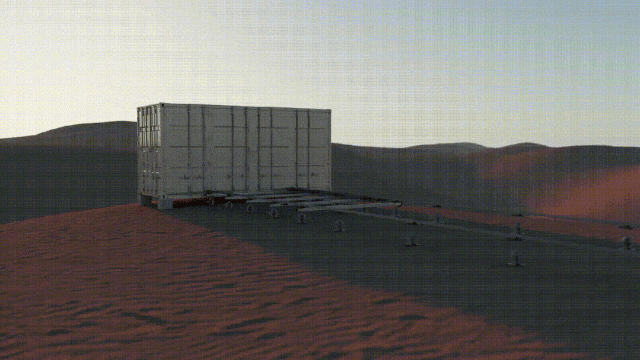
The Solar Container's design directly addresses the pain points of energy supply: traditional fixed photovoltaic power plants struggle to cope with remote, temporary, or disaster-prone scenarios, while diesel generators face problems such as fuel dependence, high emissions, and high maintenance costs. The Solar Container achieves the revolutionary concept of "one container, one power station" by integrating high-efficiency photovoltaic modules and energy storage systems within a robust container. Its outer shell is made of industrial-grade materials, ensuring stable operation during long-distance transportation and in harsh environments. A unique folding and extending mechanism allows the entire system to switch from transportation to power generation in minutes, making operation extremely simple.
The accompanying intelligent management system can monitor power generation, energy storage, and load status in real time, dynamically optimizing energy distribution efficiency and further improving overall utilization. This design not only solves the problem of uneven energy distribution in time and space but also effectively blurs the technological boundaries between photovoltaics, energy storage, and buildings. When a mobile power station can be transported and quickly deployed by an ordinary truck, the portability advantage of Solar Container becomes apparent. Industry observers generally believe that this "plug-and-play" characteristic is the key difference between it and traditional solutions.
Market Drivers in the Global Energy Transition Wave
Currently, more than 130 countries worldwide have clearly set carbon neutrality targets, and the demand for photovoltaics, as a core carrier of low-carbon energy, is growing exponentially. Solar Container has emerged in this macro context: the mobile microgrid it forms can precisely fill the gaps in traditional power grids in remote areas, emergency scenarios, and temporary projects. Data shows that approximately 800 million people worldwide still lack stable grid access, while Solar Containers can rapidly restore power to critical facilities within 48 hours, providing independent and reliable power support for schools, hospitals, and residential areas.
Meanwhile, continuous advancements in photovoltaic modules, inverters, and energy storage technologies have reduced the system cost of Solar Containers by 40% to 60% compared to traditional diesel generators. The adoption of advanced energy storage solutions such as lithium iron phosphate batteries further extends equipment lifespan and reduces total lifespan costs. In today's context of dwindling oil resources and increasing environmental pollution pressures, Solar Containers, with their high efficiency and environmental friendliness, have become a strategic choice for upgrading the energy structure of various countries. Analysts point out that this combination of cost advantages and policy incentives is accelerating the transition of Solar Containers from proof-of-concept to large-scale commercial application.
Analysis of the Application Potential of Solar Containers in Diverse Scenarios
The application scenarios for Solar Containers are far more extensive than imagined with traditional energy equipment. In the field of power supply in remote areas, it provides continuous power to regions difficult for the power grid to reach, such as islands, mountains, and grasslands. Its value has been proven in real-world projects in Africa, Southeast Asia, and nomadic communities in Mongolia—replacing diesel generators not only significantly reduces fuel transportation costs but also substantially reduces carbon emissions.
Regarding power support for temporary facilities, construction sites, outdoor events, and military bases are natural fits for Solar Containers. Data shows that in construction site scenarios, it can reduce installation costs by more than 30% and can be flexibly adjusted as projects relocate, avoiding long-term idleness and waste. Large-scale events such as music festivals and sporting events also benefit from its clean power supply capabilities, reducing reliance on the municipal power grid.


Emergency rescue is where Solar Containers truly shine. When the power grid is paralyzed after a natural disaster, the system can be deployed quickly to provide uninterrupted power to medical equipment, communication facilities, and rescue command. During the 2023 earthquake in Turkey, similar mobile photovoltaic container solutions successfully powered temporary hospitals, ensuring the cold chain storage of surgeries and vaccines, highlighting its strategic significance in times of crisis. Furthermore, Solar Containers demonstrate high adaptability in post-war reconstruction, agricultural irrigation, ocean-going vessels, mining operations, and even mobile office scenarios. These diverse applications clearly demonstrate that Solar Containers are not merely power generation equipment, but rather a key infrastructure for building a sustainable energy ecosystem.

Quantitative Advantages: Cost-Effectiveness, Environmental Contribution, and Long-Term Value
From a quantitative perspective, Solar Containers are particularly competitive. Compared to diesel generators, their total lifecycle cost is reduced by 40%-60%, a figure that stands out significantly in the current environment of volatile energy prices. In terms of installation costs, over 30% of initial investment can be saved in temporary projects; simultaneously, zero fuel consumption and intelligent operation and maintenance further reduce daily operating expenses.
The environmental contribution is equally significant. By replacing fossil fuels on a large scale, each Solar Container system can significantly reduce carbon emissions, providing direct support for achieving national carbon neutrality goals. In remote and emergency scenarios, its ability to restore power within 48 hours not only saves lives and property but also injects green power into post-disaster reconstruction. In the long run, with the advancement of international cooperation initiatives such as the Global Renewable Energy Corridor, Solar Containers are expected to play a central role in cross-border electricity trade and mobile energy networks. Industry commentators believe that this quantifiable advantage is leading more and more companies and institutions to reassess traditional energy solutions and embrace the future direction represented by Solar Containers.
Technological Evolution and Future Development Outlook
Looking ahead, technological iterations of Solar Containers will further amplify their potential. Continuous improvements in photovoltaic conversion efficiency, breakthroughs in energy storage density, and the deep integration of 5G and artificial intelligence into management systems will all make Solar Containers more intelligent and efficient. Imagine: several Solar Containers connected intelligently to form a distributed microgrid, not only meeting the needs of individual projects but also serving regional energy sharing. This is not far-fetched science fiction, but a reasonable extension based on existing technological paths.
When the boundaries between photovoltaics, energy storage, and modular buildings completely disappear, Solar Containers may become the embodiment of the ultimate form of energy systems. It retains the standardized advantages of containers while endowing renewable energy with a flexible spirit. Faced with the dual challenges of climate change and energy security, this innovative solution is responding to the needs of our time with a pragmatic approach.
Conclusion: Embracing Solar Containers, Ushering in a New Chapter of Sustainable Energy
Why are Solar Containers becoming the new darling of future energy? The answer is clearly written in the grand narrative of global energy transition: their portability, efficiency, cost advantages, and environmental friendliness collectively constitute unparalleled comprehensive competitiveness. For construction companies, emergency management agencies, mining companies, agricultural project developers, and infrastructure builders in remote areas, Solar Containers are no longer an option, but a strategic necessity.
If your organization is seeking efficient, reliable, and customized mobile energy solutions, the Kada Solar team under REBIO GROUP, with its deep industry experience and technical strength, can provide a full-chain professional service from needs assessment and system design to on-site deployment and subsequent operation and maintenance. Whether it's a standard configuration or personalized optimization for specific scenarios, the Kada Solar team can respond quickly, helping customers achieve maximum energy autonomy at the lowest cost.

Welcome to contact the Kada Solar team through official channels to begin your Solar Container customization and procurement journey. Choosing Solar Containers is not just about injecting clean electricity into projects, but also a strategic move to proactively embrace the future energy revolution. On the path to sustainable development, let us witness together how Solar Containers are reshaping the global energy landscape.


Comments