The New Energy Order: As Oil Prices Surge, Tokens are Emerging as the ‘Digital Crude’ of the AI Era
- Marine Wong

- 2 hours ago
- 4 min read
While Wall Street traders remain fixated on Brent crude benchmarks amid geopolitical volatility, a silent paradigm shift is unfolding across the Pacific. In the age of Artificial Intelligence, the fundamental unit of economic value is migrating from the carbon atom to the digital bit. We are witnessing a historic transition: if Oil was the lifeblood of the industrial age, then the Token has become the ultimate strategic resource of the AI era.

Redefining the Token: "Barreled Energy" in a Bit-Based World
Through a objective lens, we must strip away the technical jargon and return to business fundamentals. What is a Token?
In the simplest terms, a Token is the minimum unit of text processed by a Large Language Model (LLM). Just as a gallon of Oil drives an internal combustion engine for a specific distance, a Token represents a discrete encapsulation of human intelligence powered by computational resources.
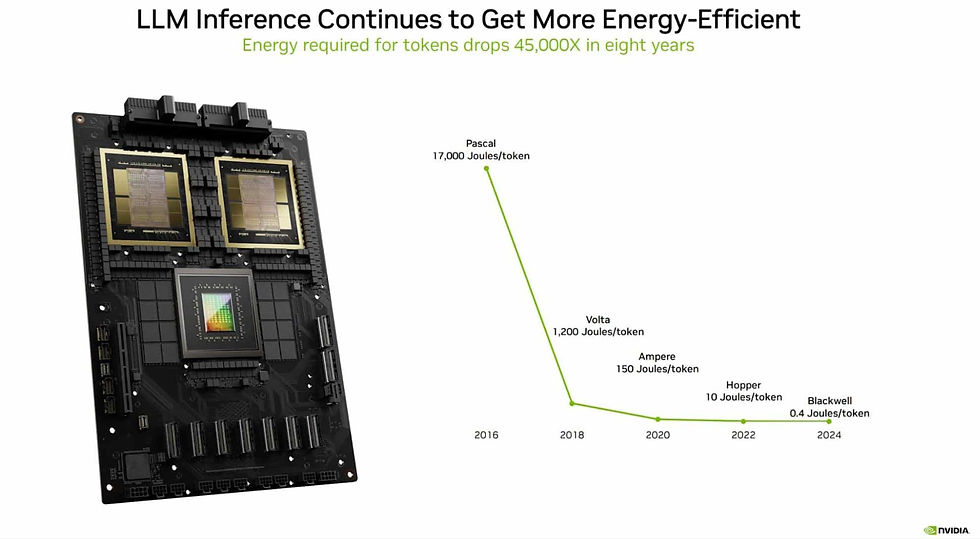
The deeper logic, however, is that Token production is essentially the "crystallization of electricity." Generating one trillion tokens requires thousands of kilowatt-hours. According to quantitative data from the OpenRouter aggregation platform as of February 2026, global token consumption among the top ten models has surpassed 27 trillion units. This confirms that Tokens are no longer just a billing tag for software; they are directly tethered to underlying energy costs. In the context of AI, a Token is "barreled digital crude." When global Oil supplies are constrained and energy costs spike, the entity capable of producing Tokens at the lowest cost and highest stability holds the pricing power of the future.
From Oil Wells to Power Grids: The Logic of China’s Token Export Strategy
Just as certain nations leveraged vast Oil reserves to influence global markets, China is utilizing its hyper-scale power infrastructure to architect a "Token Export" strategy.
This is no coincidence. A deep dive into industry media reveals a clear structural logic: Power infrastructure is the foundation, computing power is the medium, and the Token is the final deliverable.
China possesses the world’s most stable power grid and the largest renewable energy capacity. In China’s western regions, green electricity prices range from 0.2 to 0.3 RMB/kWh—starkly contrasting with the 1.0 to 1.5 RMB/kWh seen in Western markets. This massive energy price delta translates directly into a Token price advantage.
Quantitative data highlights this trend: In the February 2026 OpenRouter rankings, Chinese models (such as MiniMax, Kimi, Zhipu, and DeepSeek) surpassed U.S. models in token consumption for the first time, capturing 61% of the global market share. MiniMax’s M2.5 model alone reached 2.45 trillion tokens in a single week. Global developers are flocking to Chinese APIs because, at equivalent performance levels, the unit price of a Chinese Token is a fraction of its Silicon Valley counterparts.
This model is being hailed as "Value Export without Physical Transit." Electricity isn't sent across borders via wires; it is converted into thermal energy on GPUs, encapsulated into Tokens, and delivered globally via fiber-optic cables. China is effectively monetizing surplus green energy into a global hard currency: the Token.

Energy Security and Data Sovereignty: Lessons from the Rubble
CNBC recently reported on a major U.S. tech giant’s data center in the Middle East being targeted in a kinetic strike. This event is more than a geopolitical friction point; it is a warning regarding the vulnerability of the global AI supply chain.

In the Oil era, energy security meant keeping shipping lanes open. In the AI era, energy security and data security have merged into a single entity. If a nation's computing power is entirely dependent on a foreign cloud, its digital sovereignty is as fragile as a dry oil well.
The destruction of that data center proves that Token production hubs must be situated on land with energy self-sufficiency and grid resilience. China’s "East-to-West Computing" project places these hubs deep within its interior, far from potential geopolitical frontlines, supported by a robust UHV (Ultra-High Voltage) grid. This security gives Chinese-produced Tokens the attributes of a "safe-haven asset" in addition to price competitiveness.
Strategic Insight: How Tokens Reshape Global Trade
We must recognize that Token Export is a higher evolution of trade than e-commerce or even Electric Vehicles.
In the past, China exported physical goods or Oil derivatives. Today, it exports pure "Computational Value."
Near-Zero Marginal Cost: Once the power infrastructure and compute clusters are operational, the cost of generating one additional Token is negligible.
Circumventing Trade Barriers: Physical goods are subject to tariffs and shipping bottlenecks. Tokens, delivered as API calls, possess high liquidity and are far more difficult to obstruct with traditional trade barriers.
Redefining Pricing Power: When over 50% of the world's AI applications are calling Tokens powered by Chinese electricity, China effectively gains a seat at the table for the foundational profit distribution of the global AI ecosystem.
This is precisely why we define the Token as the "Oil of the AI Era." He who controlled Oil controlled the engines of industrial nations; he who controls the supply and pricing of Tokens controls the cost center of global intelligence.


Comments