[Insight] Energy Storage Demand to Exceed 4000GW in "Net Zero Scenario"
- Matthew Dung

- Oct 11, 2025
- 7 min read
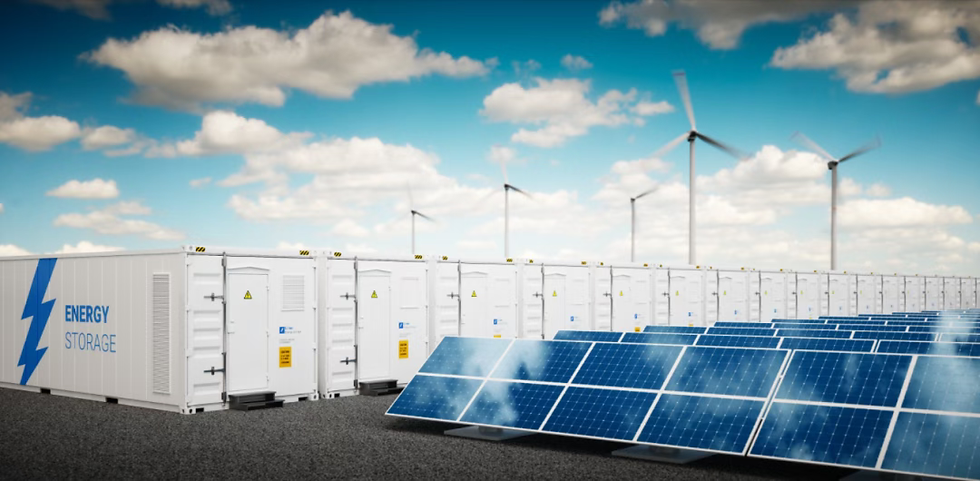
Not long ago, a significant policy document illuminated the future of energy storage. On September 12, the National Development and Reform Commission and the National Energy Administration issued the Special Action Plan for the Large-Scale Construction of New Energy Storage (2025-2027). The plan sets a target for China's new energy storage installed capacity to reach over 180GW by 2027. As of the end of the first half of 2025, the domestic installed capacity of new energy storage stood at 94.91GW. Assuming a 4-hour backup duration, the annual average installed capacity over the next two years is projected to reach 136GWh, a 34% increase compared to the 101GWh added in 2024.
According to a research report by Kaiyuan Securities, the introduction of the new energy storage action plan signals clear government support for energy storage development, with demand backed by policy. Meanwhile, regions such as Ningxia, Gansu, Xinjiang, Shandong, and Hebei have been exploring capacity compensation or electricity pricing policies tailored for new energy storage, continuously improving the commercial model and profitability of energy storage projects. The combined efforts of central and local policies are expected to drive a rebound in energy storage demand and foster the growth of the domestic energy storage industry.
In fact, 2024 marked a historic high for domestic energy storage installations. According to CNESA data, the newly commissioned energy storage capacity in 2024 reached 43.7GW/109.8GWh, reflecting year-on-year growth of 103% and 136%, respectively. This strong growth momentum continued into 2025, with CNESA data showing that the first half of 2025 saw an additional 23.03GW/56.12GWh of new energy storage commissioned, a year-on-year increase of 68% for both metrics.
Behind this growth are significant cost reductions in energy storage systems and the full implementation of electricity marketization.
As of 2024, lithium-ion batteries, particularly lithium iron phosphate (LFP), accounted for 96% of the cumulative installed capacity of new energy storage. According to a report by Xingye Securities, the price of LFP for energy storage dropped from 158,000 yuan/ton in January 2023 to 32,900 yuan/ton in August 2025, a 79% decline. In terms of domestic tenders, the price of 2-hour lithium battery energy storage systems fell from 1.35 yuan/Wh in January 2023 to 0.48 yuan/Wh in July 2025, a 64% reduction.
With the full implementation of electricity marketization, factors such as negative electricity prices and wider peak-valley price differences have made equipping photovoltaic (PV) power stations with energy storage systems a critical factor for investment returns. According to Xingye Securities' calculations, for a 100MW PV power station with a system investment of 2.45 yuan/W, an annual effective utilization of 1,400 hours, and an on-grid electricity price of 0.24 yuan/kWh, equipping the station with a 20% 2-hour energy storage system yields a higher internal rate of return (IRR) when the curtailment rate exceeds 5.8%, demonstrating better economic viability.
Following the release of Document No. 136, the era of mandatory energy storage allocation has ended, and the energy storage market is transitioning to a market-driven phase. Coupled with robust overseas demand, the growth potential of the energy storage market is substantial. According to the BP World Energy Outlook 2024, achieving net-zero emissions in the global energy system by 2050 under the "Net Zero Scenario" will require a 14-fold increase in wind and solar capacity, driving energy storage demand to exceed 4000GW.

PV Giants Deeply Engage in the Energy Storage Industry Chain
The vast growth potential of the energy storage market has attracted significant interest from PV companies. For instance, recent media reports indicate that a leading PV company, previously adamant about not entering the energy storage sector, is now planning to do so through mergers and acquisitions. Meanwhile, forward-thinking PV companies have already reaped the benefits of this energy storage boom.
In the first half of 2025, companies like Canadian Solar (CSIQ), one of the few profitable main-chain enterprises, and Sungrow, which saw significant performance growth in inverters, owe much of their success to their energy storage businesses.
Take Canadian Solar as an example. According to its financial report, the company achieved a net profit attributable to shareholders of 731 million yuan during the reporting period, with contributions primarily from its high-quality PV business and rapidly growing energy storage business. In Q2, energy storage deliveries reached 2.2GWh, a quarter-on-quarter increase of over 140%. By the end of the reporting period, the company had secured energy storage system contracts worth $3 billion. It forecasts Q3 energy storage shipments of 2.1–2.3GWh and full-year shipments of 7–9GWh, making energy storage a core driver of profit growth.
Sungrow's financial report shows that its revenue and net profit attributable to shareholders grew by 40.34% and 55.97%, respectively, both reaching historic highs. Its energy storage system business grew by 127.78%, accounting for 40.89% of revenue and surpassing its PV inverter business for the first time, becoming the core driver of performance growth.
Beyond Canadian Solar and Sungrow, other PV companies have also made smooth progress in their energy storage businesses. Trina Solar disclosed in its 2025 interim report that its energy storage business had shipped over 12GWh by the end of the first half of 2025, with an additional 800 million yuan invested in its subsidiary, Trina Energy Storage. JinkoSolar reported in its 2024 annual report that its energy storage system production line is steadily operational, with self-developed key components entering mass production. Its energy storage system shipments exceeded 1GWh in 2024, with a target of approximately 6GWh in 2025.
Notably, these PV giants are not merely chasing short-term profits but are deeply engaging in the energy storage industry chain. In the electrochemical energy storage chain, the upstream segment focuses on battery cells, while the midstream includes battery packs, battery management systems (BMS), energy management systems (EMS), power conversion systems (PCS), and other electrical equipment for system integration. The highest-value segments are battery cells and PCS, accounting for 47.2% and 26% of the total system cost, respectively. Drawing from the power battery market, leading companies in the battery cell segment often command significant market share, with the top five (CR5) accounting for over 70% of the lithium battery market from 2021 to 2024.
To gain industry dominance and secure profit margins, PV companies are extending into high-value segments. For instance, JinkoSolar’s 2024 annual report reveals that its 12GWh energy storage system and 12GWh battery cell projects, with a total investment of 8.43 billion yuan, are under construction. Trina Solar’s 2025 interim report notes that its 12GWh energy storage battery project (Phase I) in Yancheng Dafeng is under construction, with R&D efforts focused on advanced technologies such as 587Ah high-capacity battery cells.

Technology R&D and Brand Reputation Shape the Future
As more companies dive into the energy storage market, will it follow the path of intense competition seen in the PV industry? Currently, most companies’ energy storage businesses enjoy high gross margins—for example, Sungrow’s energy storage system business reported a 39.93% gross margin in the first half of 2025, while Canadian Solar’s was 30.84% in 2024.
From an industry lifecycle perspective, with significant cost reductions in energy storage systems and supportive policies, the energy storage industry officially entered its growth phase in 2025. Typically, in the early growth stage, companies with first-mover advantages reap significant benefits. For instance, in the PV industry, companies that adopted monocrystalline technology over polycrystalline or iterated to N-type battery technology early on secured excess profits.
However, as more competitors enter the market, without strong competitive barriers, intensifying competition can significantly reduce industry-wide profit margins. In the power battery sector, for example, the gross margin of leading company CATL has dropped from over 30% before 2018 to around 25% today, with most second- and third-tier manufacturers falling below 20%.
As a sector closely related to power batteries, the energy storage industry is likely to face intensified competition, potentially leading to a decline in overall profitability. A concerning trend is the rapid influx of capital into the energy storage race. According to Laimi PEVC data, since 2025, the energy storage sector has seen 133 investment and financing events, with total funding exceeding 5.8 billion yuan. CATL’s founder, Zeng Yuqun, recently expressed concerns at an industry summit, stating, “This year, the price war has spread to overseas markets, not only rapidly eroding energy storage companies’ gross margins but also proving to be a losing proposition.”
So, are there still variables that can unlock profit potential in the energy storage market?
From a technical perspective, the drive for cost reduction is pushing energy storage battery cells toward higher capacities. Larger-capacity cells reduce system integration complexity, increase system energy density, and decrease the number of cells and components needed per system, thereby lowering the overall unit cost. Previously, the energy storage market adopted 280Ah cells from the power battery sector, but since 2023, domestic energy storage cell production has shifted from 280Ah to 314Ah, with a gradual transition to 400+Ah cells. Data shows that in 2024, 314Ah cells achieved a penetration rate of over 40%, with production capacity conversion exceeding 50%.
As mentioned earlier, companies like Trina Solar have already begun R&D on high-capacity cells, ensuring their future market competitiveness and even securing product premiums. Data indicates that in early July 2024, the average price of 314Ah cells was 0.03 yuan/Wh higher than 280Ah cells.
From a market perspective, overseas electricity markets are highly marketized, with customers less sensitive to price compared to domestic markets. They prioritize project experience and brand reputation, which creates a significant compounding effect for established brands. For example, in recent years, Sungrow, Canadian Solar, and BYD have secured multiple projects with the same developers. Additionally, energy storage systems have long service lives, meaning system delivery is just the beginning of the sales process. Extensive maintenance work follows, requiring robust after-sales service capabilities from brands. This long-term operational nature ensures that leading companies maintain their dominance.
Thus, even as the energy storage market enters a phase of intense competition, leading companies with comprehensive industry chain layouts, technological advantages, and strong brand reputations will continue to achieve substantial profitability. Like CATL, despite facing competitive pressures, their gross margin remains impressive within the broader manufacturing sector.
For cutting-edge solutions and opportunities in the energy storage sector, explore how Kada Energy is driving innovation and sustainability.

![[Insight] Q3 Central and Eastern Europe Commercial Battery Storage: Poland Reigns as Revenue Powerhouse](https://static.wixstatic.com/media/353844_035d6f77835a49708452be9bcb6d5ac8~mv2.png/v1/fill/w_980,h_427,al_c,q_90,usm_0.66_1.00_0.01,enc_avif,quality_auto/353844_035d6f77835a49708452be9bcb6d5ac8~mv2.png)


Comments