AI Tactical UGV Platforms Move Toward the Front Line: What the “Brain + Body” Model Means for Open Unmanned Ground Vehicles

Updated: Jul 21

AI Tactical UGV Platforms Are Moving From Demonstration to Deployment
In unmanned systems, aerial drones have already moved from experimental use to large-scale operational deployment. Ground robotics is now entering a more complicated, but potentially more decisive, phase.
The unmanned ground vehicle, or UGV, was once widely viewed as a remote-controlled vehicle for explosive ordnance disposal, reconnaissance, patrol or logistics. That definition is changing. As artificial intelligence companies enter the tactical UGV platform market, the UGV is becoming a mobile node that can carry perception systems, navigation software, communications links, payload modules and human-machine teaming functions.
Recent industry moves point in the same direction. Overland AI said in February 2026 that it raised $100 million to scale autonomous ground systems with U.S. Armed Forces end users, with demand focused on ULTRA, its autonomous ground vehicle.
SteerAI, launched by Abu Dhabi’s Advanced Technology Research Council commercialization arm VentureOne, describes its technology as an AI-powered mobility system that can transform standard industrial vehicles into autonomous platforms.
Milrem Robotics said in 2025 that SteerAI’s CoreX autonomy system makes existing fleets autonomous through AI, perception sensors, cameras and lidar, with a fleet management system that supports operations in complex terrain.
BlueSpace.ai positions its software around assured and explainable AI for navigation and autonomy, using what it calls 4D predictive perception to support safer autonomous driving systems.
Why AI Companies Are Moving Into Tactical UGV Platforms
The entrance of AI companies into the UGV market is not accidental. Tactical ground autonomy is one of the hardest environments for artificial intelligence to master, and one of the most valuable if it succeeds.
Aerial drones operate in three-dimensional space. Tactical UGVs operate in fragmented, obstructed and physically unforgiving environments. Mud, sand, rocks, snow, rubble, slopes, urban ruins, low obstacles and intermittent communications all affect movement. If an autonomous system can operate reliably on the ground, its credibility rises sharply.
SteerAI represents one pragmatic approach. Rather than requiring customers to replace every vehicle, its model focuses on converting existing vehicles into autonomous fleets. That lowers the adoption barrier and fits the procurement logic of many defense, security and industrial users.
Overland AI represents a more vertically integrated path. Its public material focuses on autonomous ground systems for defense and national security, and its 2026 funding announcement said the company would expand manufacturing, field support and operational integration teams as demand for ULTRA grows. This indicates that software alone is not enough. Ground autonomy requires sensor placement, chassis control, power management, payload integration, communication links and field maintenance.
BlueSpace.ai’s emphasis on perception points to another constraint. The challenge is not merely whether a UGV can move. It is whether the system can see, interpret and react to the terrain around it. The conclusion is clear: AI companies are entering the UGV sector because control over perception, autonomy, fleet coordination and mission software may define the next stage of tactical ground robotics.
The New Industrial Model: AI Provides the Brain, UGV Platforms Provide the Body
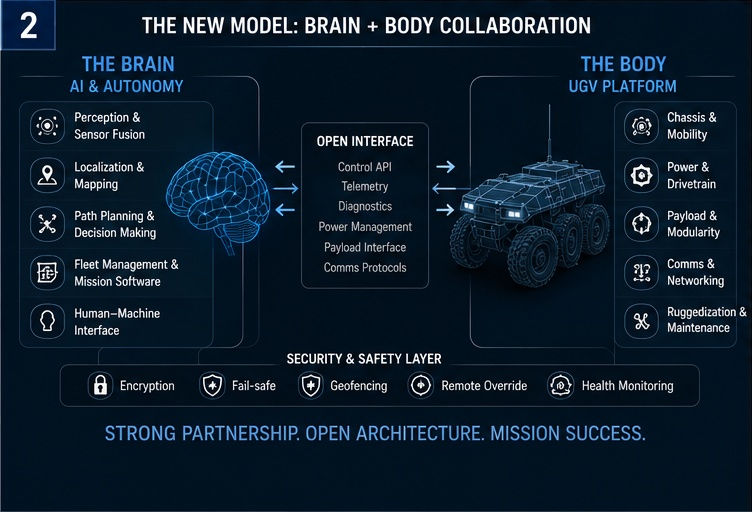
A growing number of cases suggest that the tactical UGV market is moving toward a “brain + body” model.
AI companies provide perception, sensor fusion, localization, path planning, mission software, fleet management and human-machine interfaces. UGV platform companies provide the chassis, drive-by-wire architecture, suspension, steering, braking, power supply, thermal management, sealing, structural strength, payload capacity and field repairability.
This is not a simple software-hardware subcontracting relationship.
It is a high-value partnership. In tactical conditions, the smartest autonomy stack is limited by the physical platform beneath it. If the chassis cannot cross broken terrain, the AI cannot complete the route. If the power system is unstable, sensors and onboard computing cannot operate continuously. If communication and control interfaces are closed, external autonomy software cannot enter the vehicle control loop. If payload capacity is insufficient, the platform cannot carry mission equipment that matters.
The reverse is also true. A rugged chassis without open autonomy integration will remain limited to narrow use cases. If a vehicle cannot accept different navigation systems, autonomy stacks, communications modules and payloads, it will be locked into a closed supplier ecosystem.
The future competition in tactical UGV platforms will therefore not be decided only by vehicle speed or algorithm quality. It will be decided by how reliably the brain and body work together.
Critical Integration Points: Interfaces, Control, Communications and Safety Boundaries
Open Control Interfaces
A tactical UGV platform must expose stable and well-defined control interfaces to upper-layer autonomy systems. These include speed, steering, braking, turning radius, vehicle status, attitude, battery level, drivetrain condition and fault diagnostics.
If the interface is closed, AI can only remain at the outer layer of remote operation. Open interfaces allow customers to choose different autonomy systems, navigation modules and mission software without being locked into a single vendor.
Real Payload Capacity Under Field Conditions
Many UGV prototypes can demonstrate autonomous movement. Performance changes when the platform carries communications systems, electro-optical payloads, drone modules, logistics boxes, casualty evacuation modules or sensor suites.
This is why payload capacity is a central metric for tactical UGV platforms. The vehicle must maintain mobility, braking performance, stability and safety redundancy under load. AI can plan the route, but the chassis must physically complete it.
Communications in Weak and Interrupted Networks
Ground communications are more vulnerable to obstruction than aerial communications. Mountains, urban terrain, forests, underground spaces and contested electromagnetic environments can all degrade connectivity.
A tactical UGV cannot depend only on high-bandwidth and always-on communications. It needs remote control, follow-me operation, autonomous fallback, lost-link safety behavior, and the ability to coordinate with drones, unmanned vehicles and command nodes through resilient networking.
Clear Safety Boundaries
Autonomy does not remove the need for human oversight. It makes safety architecture more important.
Emergency stop, remote override, degraded operation, geofencing, mission permissions and event logging all become part of the system. The AI “brain” must know when to act, when to pause and when to request human confirmation. The UGV “body” must execute those commands reliably.
Industry Cases Show That UGVs Are Becoming Multi-Mission Platforms
Overland AI’s ULTRA is positioned for operational integration with military units, and the company said the new funding would support growing demand for autonomous ground vehicles across U.S. and allied users. This shows that tactical UGVs are being considered not merely as vehicles, but as multi-mission assets.
SteerAI’s approach shows another market path. By converting standard vehicles into autonomous platforms, the company addresses users who want autonomy without replacing all existing assets. VentureOne’s announcement said SteerAI’s system allows vehicles to respond to hazards, maneuver around obstacles and operate in challenging or unmapped environments.
Milrem Robotics’ partnership with SteerAI further supports the same logic: autonomy can be inserted into unmanned vehicles through AI, perception sensors and fleet management systems rather than built only as a closed vehicle product.
These examples do not mean AI companies will replace UGV platform companies. They suggest the opposite. The stronger the AI system becomes, the more it needs a reliable, open and payload-capable ground platform.
REBIO TerraMate: An Open Tactical UGV Platform Path

Against this industry backdrop, the REBIO TerraMate UGV platform is positioned not as a closed vehicle product, but as an open tactical mobility platform for mission integration.
The TerraMate family is described in REBIO product materials as being built for rough terrain, water crossing, rapid deployment, unmanned logistics and mission-critical mobility. The same material highlights power, passability, reliability and modularity as core platform principles.
The TerraMate 4x4 and TerraMate 6x6 data show that these are not lightweight demonstration vehicles. They are designed around mobility, payload and integration.
The TerraMate 4x4 is an extreme off-road drive-by-wire chassis optimized for mud, sand, rocks and deep snow. According to REBIO product material, it has a size of 2700×1500×1000 mm, a payload of 500 kg, a maximum speed of 40 km/h, range of at least 150 km, gradeability of 60%, 0–50 km/h acceleration in under 3 seconds, and IP67 protection.
The TerraMate 6x6 is positioned as an airdrop-capable unmanned transport platform with a hybrid range-extender option. According to REBIO product material, its size is 2400×1500×1350 mm, with an 800 kg payload, 60 km/h speed, at least 110 km range, 70% gradeability, 0–50 km/h acceleration in under 3 seconds, and IP67 protection.
For overseas buyers, test-backed parameters matter. A third-party test report index for a TerraMate 6x6 chassis-based unmanned field catering vehicle project states that the tested vehicle was developed using the REBIO TerraMate 6x6 mobile platform chassis and submitted for third-party inspection after conversion into an unman ned military or field catering vehicle. The report was issued on March 21, 2025, by Shenzhen Jingli’an Testing Co., Ltd., and the cover displayed CMA, CNAS and ILAC-MRA marks. The same test index records six-wheel drive, 300 mm wading depth, 800 kg effective payload, 600 km driving range, 60 km/h paved-road speed, 30 km/h sand-gravel-road speed, 35-degree gradeability, 7 kW / 220 V external power output, in-place turning and ad hoc networking among UAVs, unmanned delivery platforms and unmanned vehicles.
The value of TerraMate is therefore not limited to chassis performance. Its commercial relevance lies in the possibility of becoming an open carrier for different AI systems, communications links and mission payloads.
For AI companies, TerraMate can provide a rugged tactical “body” with strong passability and payload capacity. For system integrators, it can carry communications equipment, electro-optical payloads, radar, CBRN detection modules, drone modules or logistics modules. For military and security users, it can reduce dependence on a single algorithm vendor, payload vendor or communications vendor.
Open Communications Interfaces May Become a Hidden Procurement Driver
In earlier UGV procurement, buyers often focused on speed, payload, range and price. As AI companies enter the field, open communications and control interfaces are becoming more important.
The reason is simple. AI systems evolve faster than vehicle platforms. The autonomy stack a customer selects today may be upgraded in three years. The tactical network used today may be replaced by a new communications architecture. The sensor suite installed today may become lighter, cheaper and more accurate.
If a UGV platform is closed, every upgrade may require the buyer to return to the original supplier. Open interfaces preserve customer choice. They allow users to replace the AI “brain,” change communications modules, update payloads and configure vehicles according to different national, operational and budget requirements.
This matters especially in export markets. Customers in the Middle East, Southeast Asia, South Asia and Central Asia may not share the same procurement logic. Some prioritize maximum performance. Others prioritize cost and maintenance. Some require local assembly. Others need compatibility with existing tactical communications and mission systems.
An open tactical UGV platform is better suited to these fragmented requirements.
From this perspective, TerraMate 4x4 and TerraMate 6x6 are not merely vehicle models. They can operate as a mobile chassis ecosystem in which AI companies, payload suppliers, communications companies and local integrators can all participate.
Tactical UGV Competition Will Be Decided by Open Platforms and Ecosystem Integration
The move of AI companies into tactical UGV platforms is not a short-term headline. It is a structural industry change.
Overland AI, SteerAI and BlueSpace.ai show that perception, autonomy, fleet management and mission software are becoming critical competitive layers in the UGV market.
But tactical UGVs will not be defined by AI companies alone. A usable unmanned ground system must also have a reliable chassis, open control interfaces, strong payload capacity, off-road mobility, communications adaptability and field maintainability.
The “brain + body” cooperation model is becoming a central path for tactical UGV development. AI companies provide autonomy and mission intelligence. UGV platform companies provide mobility, power, payload and engineering reliability. The integration between them is not just a software connection to a machine. It is a full coupling of control, communications, power, payload, safety and maintenance.
In this context, REBIO TerraMate offers a clear proposition: an open tactical UGV platform designed for integration. TerraMate 4x4 emphasizes passability, mobility and medium payload capacity. TerraMate 6x6 emphasizes high payload, off-road transport and mission module integration. Both platforms are designed for complex terrain, rapid deployment and mission payload integration, with IP67 protection and open platform logic.
For AI companies, system integrators and military or security customers looking for a ground robotics partner, the question may no longer be whether they need a UGV. The more relevant question is whether they need a closed vehicle product or an open platform that can continue to evolve.
The direction of the market is becoming clearer. The future tactical UGV will not be merely a vehicle. It will be an open, integrable, upgradeable and collaborative ground intelligence node. That is where the opportunity for REBIO TerraMate begins.


Comments