Tracked and Wheeled UGVs Are Not Substitutes: Ground Robot Procurement Is Moving Toward Mission-Specific Platforms

Updated: Jul 21
Tracked and Wheeled UGVs are moving from a technical category on defense exhibition floors to an application question that government, security, emergency and defense customers must answer before procurement. Signals from Ukraine, European defense exhibitions and the restructuring of U.S. unmanned systems programs show that the UGV market is no longer asking only whether robots can drive autonomously. The more practical questions are now clear: which part of the mission needs the speed, payload and range of a wheeled platform, and which part needs the low-speed mobility, towing capability and close-in field performance of a tracked platform? For customers searching for tracked UGV, wheeled UGV, TerraMate UGV, IronMule UGV and mission-specific UGV, the answer is increasingly direct: tracked and wheeled platforms are not substitutes. They are mission-specific tools.
The UGV market is moving from proof-of-concept to deployable platforms
Recent third-party reporting on Ukraine’s UGV market sends a clear signal to global procurement customers: unmanned ground vehicles are moving beyond small trial fleets, demonstration vehicles and concept platforms into larger-scale, higher-frequency and more maintenance-sensitive deployment.
Business Insider reported that Ukrainian frontline units do not simply need more new models. They need a more complete service system, including training, maintenance, communications, repair systems and analytical tools. The same reporting said Ukraine’s market had around 550 UGV models and nearly 300 companies competing, with 25,000 UGVs contracted in the first half of 2026 and a full-year target of 50,000 units.
The significance of those figures is not only procurement scale. It shows that the central question in the UGV market is changing. In the past, customers often asked whether a vehicle was new enough. Now they are asking whether it can be delivered, repaired, modified and used over the long term.
That is the starting point for choosing between Tracked and Wheeled UGVs. Tracked and wheeled platforms should not be compared on a single straight line. They are built for different missions. Tracked UGVs are better suited to low-speed, short-range, rough-ground, cost-sensitive and multi-unit deployment. Wheeled UGVs are better suited to long-range, higher-speed, high-payload and complex mission-integration scenarios.
REBIO’s latest UGV messaging follows the same logic. TerraMate is positioned as a premium UGV series, carrying high-end capability and complex mission integration. IronMule is positioned as a general-purpose tracked UGV series, designed for cost-effective deployment, strong towing capability, multi-unit operation and practical field missions. TerraMate 4x4 and TerraMate 6x6 are REBIO’s key international premium models, while IronMule T150 is the key international utility model.

The core question for Tracked and Wheeled UGVs is mission boundary
In real operations, the division between Tracked and Wheeled UGVs usually does not begin with the question of whether tracks are better than wheels. It begins with mission boundaries.
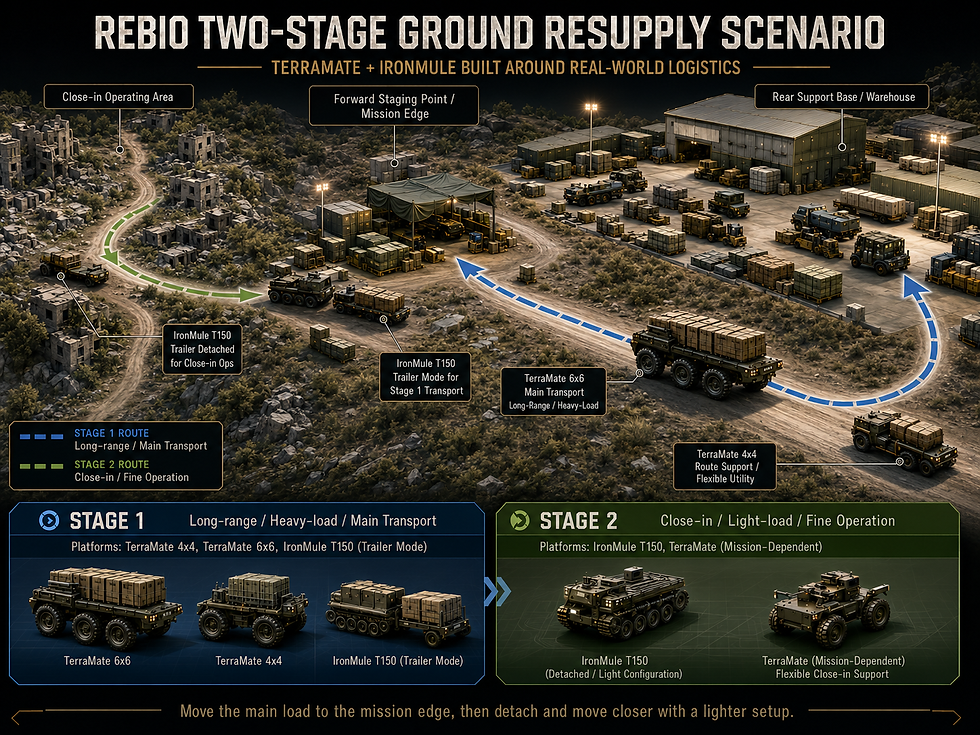
The first stage is usually to move personnel, supplies, equipment or mission payloads to the mission edge. This stage puts greater emphasis on speed, range, payload, stable power supply and repeatable transport. TerraMate 4x4, TerraMate 6x6, or IronMule T150 in trailer mode can all support this main transport stage.
The second stage begins at the mission edge and moves into close-in field work. This stage may involve mud, gravel, debris, woodland, narrow paths, slopes or temporary routes. The mission can also shift from heavy load movement to lightweight payload operations closer to the work area. IronMule T150 can detach its mission trailer and continue into more complex terrain. TerraMate can also continue forward depending on terrain, payload and mission system requirements.
This is the practical value of REBIO’s two-stage logistics concept. REBIO does not define products from laboratory specifications alone. It starts from customer scenarios and divides the mission into two stages: the first stage is long-range, heavy-load, main transport; the second stage is close-in, lighter-load, more precise field work. REBIO’s messaging makes that distinction clear: the first stage fits TerraMate 4x4, TerraMate 6x6 or IronMule T150 with a mission trailer, while the second stage fits IronMule T150 or a TerraMate platform selected according to the mission.
That makes TerraMate UGV and IronMule UGV different nodes in the same mission chain, rather than competing product lines. TerraMate addresses long range, higher speed, higher payload and complex integration. IronMule addresses low speed, short range, rough ground, lower cost, multi-unit deployment and mission trailer operations.
Ukraine’s experience reinforces platform reliability over showmanship
Ukraine’s experience shows that UGV procurement is not only a technology race. It is also a competition in repair, training, supply chain and field adaptability.
Business Insider reported that ground robots in Ukraine had already taken part in more than 50,000 missions in 2026, including equipment transport, casualty evacuation and other high-risk ground tasks. Another report noted that Ukrainian defense companies can complete testing and frontline feedback cycles within days, with some companies modifying products as many as 20 times in one month based on battlefield feedback.
That shows the UGV market is shifting from demonstration capability to usable capability. Autonomy, perception algorithms and mission software matter. But what keeps customers using a platform is often more basic: mobility, payload, power supply, maintenance, interfaces and mission adaptation.
A complete UGV robot can be understood in three parts. The brain is ROC, navigation and autonomy. The upper limbs are mission payloads. The lower body is the power chassis, drivetrain, suspension, power supply and terrain mobility. Without a reliable, powerful and open lower body, even the most advanced brain and payload cannot perform consistently. REBIO’s latest messaging emphasizes the same point: TerraMate and IronMule are essentially open power platforms for different mission payloads, navigation systems, autonomy systems and customer scenarios.
Just as combat sports first stress a stable lower body, UGV mission reliability begins with the chassis and power platform. For procurement customers, the value of a mission-specific UGV does not lie in how complex it appears at an exhibition. It lies in whether it can keep working in the field.

Wheeled UGV platforms support premium mission capability; tracked UGV platforms support scalable deployment
The division between Tracked and Wheeled UGVs eventually appears in product architecture.
TerraMate UGV is REBIO’s premium wheeled platform line. According to REBIO materials, TerraMate 4x4 has a rated payload of 500 kg and is suited to cargo transport, logistics support, reconnaissance and patrol. TerraMate 6x6 has a rated payload of 800 kg and is designed for payload missions, rescue, EOD/inspection and airdrop-related heavy-duty tasks. TerraMate 8x8 has a rated payload of 1,000 kg and addresses higher payload, more complex terrain and larger mission-system integration. REBIO’s TerraMate mobile platform family also emphasizes rough-terrain mobility, water-crossing capability, rapid deployment, unmanned logistics and mission-critical mobility across the 4x4, 6x6, 8x8 and USV platforms.
IronMule UGV follows another path. The value of IronMule T150 is not to replace larger platforms with a small vehicle. Its value lies in creating small-team deployment capability through a combination of lightweight payload, mission trailer and close-in field work. The T150 body can carry cameras, communications modules, reconnaissance equipment, small spraying modules or other lightweight payloads, while towing a mission trailer. The trailer can carry supplies, tools, batteries, sensors, rescue equipment, engineering spare parts or other mission materials. Once it reaches the mission edge, the trailer can be quickly detached, and the T150 can continue with a lightweight payload into more complex, narrower, muddier or higher-risk areas.
That is the significance of the mission trailer. It moves IronMule T150 beyond a single-vehicle payload logic and turns it into a low-cost, multi-unit, high-towing, reconfigurable platform for team-level missions. For customers, the question is not whether T150 replaces TerraMate. The question is how T150 and TerraMate can cooperate in the same mission chain.
Localized delivery is becoming the second front in UGV procurement
Once UGV numbers increase, new bottlenecks quickly appear. Training, repair, spare parts, test release, quality control, local assembly and lifecycle support all become decisive factors in whether customers continue procurement.
Reuters reported that Ukraine announced a wartime weapons export framework in July 2026, with 20% of finished defense product export revenue and 30% of component export revenue to go into a state defense fund. The report also noted that more than half of the weapons used on Ukraine’s battlefield were domestically made. This trend shows that unmanned systems competition is not only about vehicles. It is also about local industrial capability and supply chain organization.
REBIO’s overseas value develops in this area. Its value is not limited to exporting complete UGVs. It is to convert China’s mature unmanned-equipment industrial chain into localized capabilities that overseas customers can purchase, assemble, maintain and upgrade. REBIO materials show that its KD capability covers product definition, mission/payload/terrain/interface assessment, Chinese supply chain support, KD package, local assembly, test release, and long-term spare parts, upgrades and feedback loops.
For senior partners, access to TerraMate extended platforms and the overseas KD factory model package is not an add-on service. It is an industrialization path into regional markets. Defense groups, systems integrators, emergency management customers and energy facility customers can retain their customer relationships, mission systems, software, communications and payload architecture while using REBIO’s chassis, power systems, supply chain and KD delivery experience.

TerraMate’s next-generation power system shows that premium platforms are still evolving
The next round of competition for Tracked and Wheeled UGVs will not stop at current speed, payload and range indicators. As missions become more complex, customers will demand higher energy density, longer range, stronger thermal management, more stable control and better system efficiency.
REBIO materials show that TerraMate 6x6 is already in the deployed stage, with its current power system based on RFM, VCU 1.0, LFP and air cooling. The next-generation system is planned around AFM, VCU 2.0, ASSB and liquid cooling, with the aim of delivering higher energy density, longer range and stronger mobility. REBIO’s latest UGV messaging summarizes this point clearly: TerraMate is not a static product. It is an evolving platform. It has been validated, but it is not stopping at already validated performance.
This has two meanings for customers. First, TerraMate UGV is a premium wheeled platform that can be deployed now. Second, TerraMate is also a platform for co-developing next-generation capability. For senior partners, this “deploy one generation, develop the next” route has more long-term value than a one-time procurement.
IronMule supports the scalable deployment side. As REBIO’s long-term product roadmap develops, mature technologies applied in the TerraMate series can gradually evolve into the IronMule series. This layered strategy allows REBIO to serve high-end mission platform needs while also supporting small-team, multi-unit and cost-effective practical missions.
Mission-specific UGV is the next procurement language
The global UGV market is entering a more practical stage. Business Insider’s reporting on Ukrainian UGVs shows that customers need more than additional models. They need complete solutions. The U.S. Department of Defense has also moved to create a new unmanned systems management office covering ground robots, surface platforms, AI autonomy systems and counter-drone technologies.
That means the discussion around Tracked and Wheeled UGVs is shifting from technical classification to mission division. Wheeled platforms move the main payload quickly and reliably to the mission edge. Tracked platforms continue the work in closer, narrower and rougher areas. TerraMate 4x4/6x6, IronMule T150 trailer mode, mission edge, close-in field work and mission trailer should be understood as parts of one operating system.
REBIO’s product logic fits this change. TerraMate defines the upper range of premium UGV capability. IronMule lowers the cost of scalable UGV deployment. TerraMate and IronMule together serve two-stage logistics. REBIO’s two UGV series have accumulated more than 1,000 units delivered worldwide, with the TerraMate series alone reaching approximately 400 global deliveries and no recorded customer complaints. That gives customers something more important than a concept vehicle: delivery validation.
The future winners in UGV may not be the companies that best demonstrate autonomous driving algorithms. They may be the companies that best understand mission boundaries, power chassis, modular interfaces, localized delivery and long-term maintenance. Tracked and Wheeled UGVs should not be placed on opposite sides of a procurement debate. They should be placed on the same mission chain: one brings capability to the mission edge, and the other pushes capability into close-in field work.


Comments