Why UGV chassis Now Defines Field Value: When the Lower Body Starts to Reshape Ground Robotics
- Richard Geng

- 10 hours ago
- 7 min read
In recent years, UGV chassis has stopped being merely the mechanical shell of an unmanned ground vehicle. It is becoming one of the central benchmarks by which AI companies, system integrators and defence groups judge the real value of ground robotics. Algorithms can be updated. Sensors can be replaced. Mission payloads can be reconfigured. But if the UGV chassis cannot withstand real terrain, real payloads, real power demand and real maintenance pressure, even the most advanced intelligent brain remains trapped in the demonstration field.
From Concept Vehicles to Scalable Deployment: UGV chassis Is Being Repriced
The war in Ukraine has changed the discussion around unmanned systems. For years, the spotlight often fell on visible technology labels: autonomous driving, AI recognition, remote control, sensor fusion. Now, frontline experience is pulling attention back to a more basic question: can the platform survive, move, tow, carry, connect and be repaired?
In April 2026, Defense News reported that Ukraine planned to contract 25,000 unmanned ground vehicles in the first half of 2026, more than double its 2025 total. The same report cited Ukrainian officials saying that in March alone, the military carried out more than 9,000 missions using UGVs, with the broader goal of shifting frontline logistics from soldiers to robotic systems.
The significance of those numbers is not simply that more robots are being purchased. It is that UGVs are moving from small-batch experiments into a category of equipment expected to be deployable, replaceable, maintainable and scalable. For AI companies and system integrators, that means the opportunity is no longer only in software. It is also in the lower platform layer. A stable UGV chassis allows autonomy companies to focus on navigation, perception and mission logic. An open UGV chassis allows defence groups to integrate communications, electronic warfare, reconnaissance, transport, evacuation, detection, engineering or other mission modules more quickly.

Battlefield Lessons Are Converging With Industrial Common Sense
Reuters reported in February 2025 that Ukraine's military would create robotic vehicle units for the front, with unmanned ground vehicles expected to support offence, defence, logistics, casualty evacuation, mine laying and mine clearance. The same report noted that both sides were deploying tens of thousands of aerial drones each month, while officials saw a growing race to replace as many soldiers as possible on the ground with UGVs.
By mid-2026, Reuters was also reporting on a widening Ukrainian defence-startup ecosystem, including sea-drone swarms and robot trucks. The report described procurement channels through which brigades can order from roughly 800 products supplied by 200 manufacturers, and noted that publicly disclosed defence investment in Ukraine rose from 1.1 million dollars in 2023 to 105 million dollars the following year.
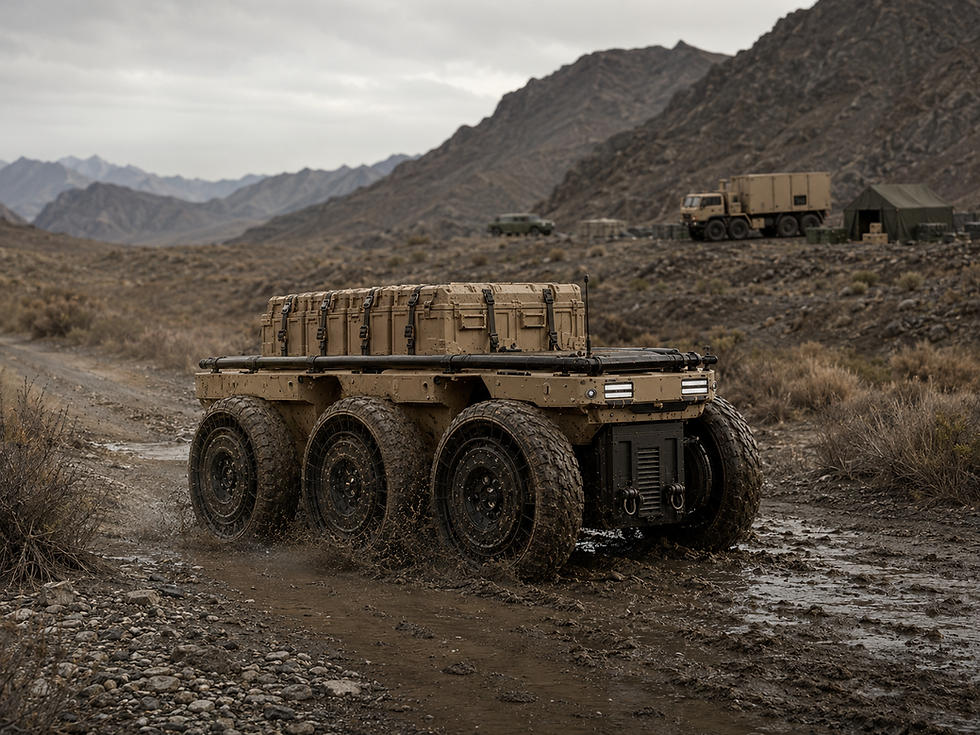
As product numbers grow, weak platforms are exposed quickly. Not every robot can enter real field conditions. Real missions require mud mobility, gravel stability, slope traction, power redundancy, fast repair, interface compatibility and payload reconfiguration. In other words, UGV chassis is moving from being an overlooked base component to becoming the infrastructure that determines whether a mission system can work at all.
This is why REBIO GROUP emphasizes the idea of the lower-body platform in its UGV business. A complete UGV system can be understood in three parts: ROC, navigation and autonomous driving form the brain; mission payloads form the upper limbs; the power chassis, drive system, suspension, power supply and terrain mobility form the lower body. Without a reliable, powerful and open lower body, even the most advanced brain and payload cannot deliver stable field value.
What AI Companies and System Integrators Need Is an Autonomy-Ready UGV chassis
AI companies are usually strongest in perception, path planning, recognition, obstacle avoidance and mission decision-making. System integrators are usually strongest in combining communications, power systems, sensors, gimbals, robotic arms, rescue modules, reconnaissance kits and special-purpose equipment. Defence groups focus on mission closure, procurement scale, maintenance systems and long-term reliability.
All three groups share one need: they do not want to be locked into a closed chassis.
The more valuable future platform is therefore not a sealed UGV that tries to do everything by itself. It is an autonomy-ready UGV: a UGV chassis strong enough at the mechanical level, open enough at the interface level, stable enough in power output, and modular enough to accept different brains and upper limbs from different countries, systems and suppliers.
A NATO video published in June 2026 made a similar point through the experience of a European ground-robotics company. Its CEO said the company's early system failed immediately at the front line, forcing it to redevelop a platform suitable for battlefield reality rather than a more compliance-driven European procurement environment. He also said several hundred of its Western-built robotic systems were on daily duty on Ukraine's frontline, and that future unmanned systems must be scalable from the early prototype stage to thousands or even hundreds of thousands of units.
That public account reveals a central truth: the field does not reward laboratory perfection. It rewards practical usability. A UGV chassis supplier that can deliver reliability, open interfaces, scalable production and local support may become the common foundation between AI companies and defence groups.

Wheeled and Tracked Platforms Are Not Substitutes. They Are Mission-Specific.
Many buyers still divide UGVs into wheeled and tracked categories, then ask one to replace the other. Real missions rarely work that way.
Wheeled platforms are better suited to longer range, higher speed, heavier payloads and more complex mission integration. Tracked platforms are better suited to low-speed, short-range, rough-ground, cost-effective, multi-unit and high-towing tasks.
REBIO's TerraMate and IronMule product logic follows this distinction. TerraMate is the premium UGV series, designed for higher-end mission capability. IronMule is the general-purpose tracked UGV series, designed for cost-effective deployment, strong towing, rough-ground use and practical field missions. TerraMate 4x4 and 6x6 are positioned as key international premium models, while IronMule serves the utility and close-in field-work side of the portfolio.
TerraMate is intended for high-mobility, high-payload, longer-range and more complex mission integration scenarios. IronMule is intended for smaller teams, tracked mobility, towing, close-in support and practical multi-unit deployment. That does not make one platform superior to the other in the abstract. It makes them different answers to different mission questions.
Two-Stage Logistics: When UGV chassis Becomes a Mission Structure
The next stage of UGV deployment may not be about making every vehicle larger. It may be about structuring missions more intelligently.
REBIO's two-stage logistics concept is one way to understand this shift. In the first stage, a larger wheeled UGV such as TerraMate moves personnel, supplies, equipment or mission payloads to the edge of the mission area. In the second stage, part of the load or trailer is detached, and a lighter operational configuration moves closer into more complex, dangerous or narrow terrain.
This logic matters for defence groups and system integrators because it turns UGV chassis from a transport tool into a mission-continuity platform. It is not only about carrying a box from one point to another. It is about reaching the mission edge, then keeping the mission alive beyond that edge.
Defense News noted that one Ukrainian logistics robot cleared for operational use under NATO cataloging standards carried a 300-kilogram payload with a 50-kilometer range. Parameters like these show that the field is accepting medium and small UGV platforms when the mission is clear and the deployment model is scalable.
TerraMate addresses the higher-payload, longer-distance and more complex integration layer. IronMule addresses the closer, rougher and more scalable layer. Together, they represent not a simple high-low product ladder, but two different rhythms of field work.

REBIO's Natural Position: A Reliable UGV Lower-Body Platform Supplier
In the current UGV competition, REBIO GROUP is most naturally understood as a reliable UGV lower-body platform supplier. That definition is more precise than simply calling it a vehicle supplier, and it is easier for AI companies, system integrators and defence groups to understand.
There are three reasons.
First, REBIO emphasizes the lower-layer value of the UGV chassis: mobility, payload capacity, power output, maintainability, interfaces and mission adaptability. It does not need to lock the customer into one navigation system or one autonomy system. TerraMate and IronMule are better understood as reliable, powerful and open lower-body platforms for different payloads, navigation systems, autonomous-driving systems and field applications.
Second, REBIO separates high-end mission capability from scalable practical deployment. TerraMate serves high mobility, high payload, long distance, complex terrain and mission-critical integration. IronMule serves cost-effective deployment, strong towing, rough-ground mobility and multi-unit use.
Third, REBIO's overseas value is not limited to exporting vehicles. Its broader value is converting mature Chinese unmanned-equipment industrial capability into localized products that overseas customers can purchase, assemble, maintain and upgrade. For selected senior partners, that can include product definition, Chinese supply-chain support, KD factory packages, platform adaptation and long-term lifecycle support.
UGV chassis Is the Realist Answer to Ground Robotics
The unmanned-systems industry likes to talk about the future. The battlefield and the field site care about the present.
Can the system move supplies in? Can it help move people out? Can it continue to operate through mud, slopes, gravel, water, low temperatures, high temperatures and unstable communications? These are the real questions facing UGV chassis.
In that sense, UGV chassis is not a quiet component. It is the realist answer to unmanned ground systems.
ROC, navigation and autonomous driving remain important. They are the brain. Mission payloads remain important. They are the upper limbs. But the force that determines whether those capabilities can enter the field is the lower body: power chassis, suspension, power output, interface design, maintenance logic and terrain mobility.
As global UGV demand moves from proof-of-concept toward scalable deployment, reliable UGV lower-body platform suppliers will become more important in the industrial chain. REBIO GROUP's TerraMate and IronMule enter the discussion from precisely this position: they do not force customers into one brain, and they do not limit customers to one payload. They provide a reliable, powerful, open and scalable UGV chassis so that different mission systems can actually reach the field.

Comments