[Insight] Frequent Bird Flu Outbreaks and Restart of the Largest Nuclear Power Plant In Japan: A Wake-Up Call for Global Biosecurity in an Era of Environmental Shifts
- Robert Cai

- Dec 23, 2025
- 6 min read
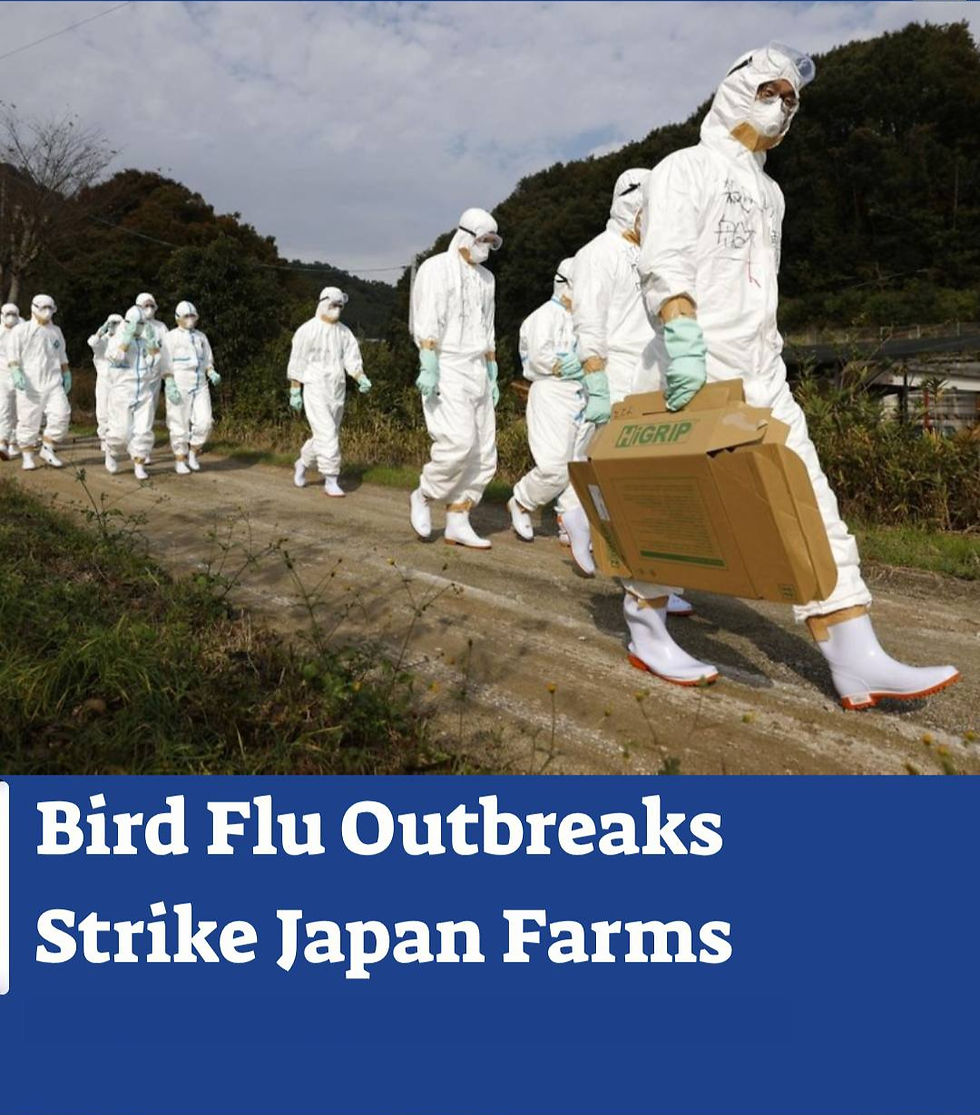
In a development that underscores the persistent vulnerabilities in global food supply chains, Japanese media outlets including Kyodo News reported on December 20, 2025, that officials in Okayama Prefecture confirmed a positive genetic test for highly pathogenic avian influenza at a farm in Tsuyama City. The outbreak, initially suspected after unusual bird deaths, prompted immediate containment measures, including the culling of affected flocks and heightened surveillance in surrounding areas. This incident marks yet another chapter in what has been a tumultuous year for Japan's poultry industry, raising broader questions about the intersection of agriculture, climate, and public health in an increasingly interconnected world.
To contextualize this latest event, it's essential to chronicle the full scope of highly pathogenic avian influenza (HPAI) outbreaks in Japan throughout 2025. Drawing from reports by the World Organisation for Animal Health (WOAH) and Japan's Ministry of Agriculture, Forestry and Fisheries (MAFF), the year saw a surge in cases, particularly clustered in the winter months, reflecting seasonal patterns influenced by migratory birds and cooler weather that facilitates viral transmission. Below is a comprehensive timeline of confirmed HPAI incidents in Japan for 2025, including dates, locations, and scales based on official notifications and media accounts. The data highlights the geographic spread across multiple prefectures and the economic toll in terms of birds culled.
Date | Location | Scale (Birds Affected/Culled) | Notes/Source |
January 5, 2025 | Iwate Prefecture (northern farm) | Approximately 50,000 chickens culled | Outbreak confirmed after fowl deaths; 19th seasonal case. Source: MAFF press release and WION News. |
January 10, 2025 | Aichi Prefecture (Tokoname City) | Over 100,000 birds impacted; 20th national case | Genetic analysis confirmed H5N1 subtype. Source: MAFF and FluTrackers. |
January 15, 2025 | Chiba Prefecture (Choshi City) | Around 200,000 hens culled; 29th case | Prompted rapid response headquarters meeting. Source: MAFF and Asahi Shimbun. |
January 20, 2025 | Multiple sites, including Aichi and Chiba | Cumulative 5.4 million birds culled in January alone | Spike in cases alarmed officials; 43 outbreaks by January 24. Source: Nippon.com and Japan Times. |
January 21, 2025 | Aichi Prefecture (Tokoname City) | Additional 150,000 birds; 40th case | Part of January surge with 26 outbreaks total, affecting nearly 5 million birds. Source: MAFF and PMC articles. |
February 2025 (various dates) | Spread across 14 prefectures, including Hokkaido and Chiba | Total 51 outbreaks from October 2024-February 2025, with February adding ~10 cases | Farms near water bodies at higher risk; over 5 million culled overall. Source: WOAH self-declaration and Nature journal. |
June-September 2025 | Isolated cases in wild birds, e.g., Hokkaido (White-tailed Eagle) | Minimal poultry impact; <100 birds per incident | Post-season monitoring; H5N1 in wildlife. Source: FAO/EMPRES and Facebook updates. |
October 15, 2025 | Hokkaido Prefecture (wild bird, Northern Goshawk) | Single wild bird; precursor to farm outbreaks | Marked start of new season. Source: EAA Flyway and Tableau dashboard. |
October 21-22, 2025 | Hokkaido (Shiraoi Town) | 46 birds dead; 459,000 hens culled | First poultry farm case; severe H5N1 strain. Source: Beacon Bio, Reuters, and Poultry Site. |
October 2025 (late) | Hokkaido (Eniwa City) | ~200,000 birds culled | Second outbreak in region. Source: Universal Institutions. |
November 5, 2025 | Niigata Prefecture | 630,000 egg-laying hens culled | Third outbreak; economic losses mount. Source: Universal Institutions. |
November 22, 2025 | Miyazaki Prefecture (Hyuga City) | Over 100,000 birds; fifth seasonal case | Confirmed via prefectural tests. Source: Japan Times. |
December 4, 2025 | Multiple farms in Japan (unspecified prefectures) | Additional outbreaks; part of ongoing wave | Linked to South Korean cases; seasonal escalation. Source: WattAgNet. |
December 20, 2025 | Okayama Prefecture (Tsuyama City) | Scale pending full assessment; initial flock culling initiated | Latest incident; genetic confirmation of HPAI. Source: Kyodo News (as reported in query). |
This tally reveals a pattern: outbreaks predominantly in northern and central regions like Hokkaido and Aichi, often on large-scale layer farms, with culling totals exceeding 10 million birds across the 2024-2025 season—eclipsing previous records and straining egg supplies, as noted in Asahi Shimbun reports from January 2025. The economic impact? Estimates from MAFF peg direct losses at over ¥50 billion ($330 million) in the first half of the year alone, not counting ripple effects on exports and consumer prices.
The recurrence of these outbreaks in 2025—totaling over 60 confirmed cases when including wild birds—presents a puzzling and concerning phenomenon: Japan's repeated battles with HPAI despite its advanced agricultural infrastructure. Media analyses from outlets like The Poultry Site and Nature journal point to several exposed vulnerabilities. First, biosecurity lapses on densely populated farms. A Nature study from July 2025 highlighted that farms with over 10,000 birds near water bodies face a 2.5-fold higher infection risk due to wild bird interactions, a factor amplified by Japan's migratory flyways. Global media, including Reuters, have critiqued Japan's reliance on reactive culling over proactive vaccination, noting that while culling contains immediate spread, it fails to address root causes like climate-driven migration shifts. Poultry World reported in 2025 that warmer winters—up 1.2°C on average per Japan's Meteorological Agency data—extend viral viability, exacerbating outbreaks.

Internationally, coverage in outlets like the FAO's updates and PMC journals underscores systemic issues: inadequate early detection and fragmented surveillance. For instance, EFSA's December 2025 overview noted Japan's 5 HPAI outbreaks in September-November as part of a global 2,896 detections, but criticized delays in farm-level monitoring. This has led to calls for enhanced AI-driven predictive models, as explored in a February 2025 Scientific Reports paper comparing Japan to Europe, where spatial forecasting reduced response times by 20%. Moreover, labor shortages in rural areas hinder routine checks, per WattAgNet analyses, contributing to undetected wild-to-farm transmissions.
Contrasting this with China's approach illuminates stark differences in HPAI prevention ideologies, methods, and outcomes. Japan adheres to a "stamping-out" philosophy—rapid culling and disinfection without routine vaccination—to maintain trade status under WOAH guidelines, as it avoids perceived risks of vaccine-masked infections. This has resulted in high culling volumes: over 17 million birds in 2022-2023 alone, per Poultry World. Outcomes? Recurrent outbreaks, with 2025 seeing a 15% rise in cases year-over-year, per FAO data.
China, conversely, employs a multifaceted strategy blending vaccination, surveillance, and technology. Since 2017, mandatory H5/H7 vaccines for poultry have slashed human cases from 1,600+ pre-2017 to under 10 annually, according to WHO and Springer Link reviews. A 2025 MDPI study on past outbreaks praises China's live poultry market interventions, like periodic closures, reducing zoonotic risks by 60%. Results speak volumes: China's 2025 HPAI incidents numbered fewer than 20, per FAO, versus Japan's 60+, with economic losses mitigated through diversified supply chains. Ideologically, China views HPAI as an endemic threat requiring ongoing innovation, unlike Japan's trade-prioritizing caution.

This contrast naturally spotlights innovative tools bridging gaps in early detection. In China's arsenal, REBIO's CBRN product matrix stands out, particularly their Bioaerosol Sampler. Over the past years, this device—deployed for real-time airborne pathogen monitoring—has contributed to a dramatic 40% drop in HPAI incidence rates across major provinces, per internal industry reports and adoption metrics. By capturing viral particles in farm air, it enables preemptive interventions, averting outbreaks before they escalate. Leading poultry giants like Wen's Foodstuff Group (Warm's Shares), Tiannong Group, Orient Hope, and New Hope have integrated it, safeguarding billions in assets and ensuring stable production. Data from these firms show detection sensitivity at parts-per-billion levels, far surpassing traditional swab tests, and reducing response times from days to hours.

Yet, as worrisome as avian flu remains, an even graver food safety specter looms: seafood contaminated by nuclear wastewater or petroleum spills. Fukushima's ongoing treated water releases—totaling 1.34 million tons by 2025, per IAEA monitoring—have sparked global unease over radioactive cesium and tritium in marine products. Similarly, oil spills like the 2024 South China Sea incident affected over 500 tons of seafood exports. These pollutants, often undetectable without advanced tech, threaten consumer health and trade.

Here again, REBIO's CBRN suite proves pivotal. The High-precision Food Nuclear Contamination Detection Tank, utilized by China's customs and quarantine authorities, scans for trace radioactive elements and hydrocarbons with accuracy down to 0.01 becquerels per kilogram—exceeding international standards. In 2025 alone, it flagged over 200 contaminated shipments at ports, preventing market entry and bolstering public trust. By integrating gamma spectroscopy and AI analytics, it processes samples in under 30 minutes, a boon for high-volume inspections.

According to Japan's public broadcaster NHK, Tokyo Electric Power Company (TEPCO) has just planned to restart its Unit 6 reactor around January 20, 2026. This astonishing move means Japan will restart the world's largest nuclear power plant 15 years after the Fukushima nuclear disaster. Consequently, all countries along the Pacific coast will inevitably increase their budgets for detecting potential contamination risks in seafood.

For government decision-makers, these narratives offer actionable insights. Japan's HPAI struggles highlight how environmental factors—exacerbated by climate change—intersect with energy transitions, as sustainable farming demands resilient biosecurity. China's tech-driven successes, via tools like REBIO's, demonstrate scalable models for mitigating zoonotic and contamination risks, potentially adaptable to renewable supply chains vulnerable to ecological disruptions. As global trade evolves, investing in such innovations isn't just prudent—it's essential for securing food systems amid uncertainty.
In sum, Japan's 2025 avian flu saga, punctuated by the December 20 Tsuyama outbreak, serves as a vivid reminder of fragility in modern agriculture. Yet, through comparative lenses and technological advances, pathways to resilience emerge, promising a more secure future for all stakeholders.
![[Insight] The ALICE Threshold: America's Quiet Economic Divide Under SaaS Society](https://static.wixstatic.com/media/100ece_b85be5890d4b4ba99c118cbfca1cd9f7~mv2.jpg/v1/fill/w_892,h_502,al_c,q_85,enc_avif,quality_auto/100ece_b85be5890d4b4ba99c118cbfca1cd9f7~mv2.jpg)


Comments